Obrazy, które wyszły z kadru

Malarstwo Wilhelma Sasnala w filmie „Człowiek do wszystkiego”
Anka Sasnal i Wilhelm Sasnal „Człowiek do wszystkiego”, 2025 – kadr z filmu, fot. Marek Gardulski, dzięki uprzejmości artysty

Joanna Sokołowska-Gwizdka

Obrazy powstawały z myślą o filmie. Miały zawisnąć na ścianach eleganckiej willi, towarzyszyć bohaterom, współtworzyć atmosferę opowieści. Zanim jednak film Anki i Wilhelma Sasnalów „Człowiek do wszystkiego” trafił do kin, płótna namalowane przez Wilhelma znalazły się w amsterdamskim Stedelijk Museum. To, co miało być częścią scenografii, stało się przedmiotem osobnej artystycznej opowieści.

W tych obrazach pobrzmiewają echa wielkich mistrzów europejskiej awangardy — Henriego Matisse’a, Pabla Picassa i Georges’a Braque’a. Sasnal nie ogranicza się jednak do kopiowania ich dzieł. Podejmuje z nimi dialog, sięgając po rozpoznawalne motywy i nadając im nowe znaczenia.

Mistrzowie awangardy w willi Toblerów

Film „Człowiek do wszystkiego”, inspirowany powieścią Roberta Walsera z 1908 roku, przenosi nas między innymi do eleganckiej willi wynalazcy Carla Toblera. W jej wnętrzach, pośród mebli i przedmiotów codziennego użytku, wiszą obrazy, które przyciągną uwagę widza znającego historię nowoczesnego malarstwa.

Można tu odnaleźć znajome kształty, kolory i kompozycje. Jakby Matisse, Picasso i Braque zostali zaproszeni do domu Toblerów. A jednak żadne z tych płócien nie wyszło spod ich pędzla. Wszystkie namalował Wilhelm Sasnal, swobodnie poruszając się po świecie malarskich inspiracji.
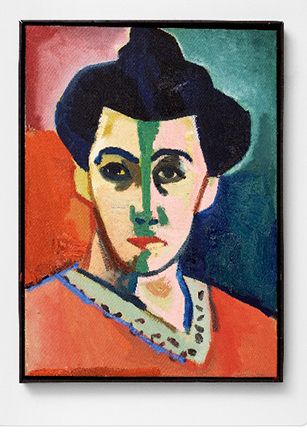
Wilhelm Sasnal
Bez tytułu (według „Zielonej kreski” Henri Matisse’a), 2023
olej na płótnie, drewniana rama, 72,5 x 52,5 cm
fot. Marek Gardulski, dzięki uprzejmości artysty

Szczególną uwagę zwraca portret z 2023 roku, nawiązujący do słynnego „Portretu pani Matisse. Zielona kreska” z 1905 roku. Henri Matisse przedstawił w nim swoją żonę Amélie, przecinając jej twarz wyrazistą zieloną smugą. Intensywne, niemal zderzające się ze sobą barwy sprawiły, że portret stał się jednym z najbardziej rozpoznawalnych dzieł fowizmu.

Ponad sto lat później Wilhelm Sasnal powraca do tej kompozycji. Znajoma twarz pojawia się w nowym kontekście, w innym czasie i w innej opowieści. W jednej ze scen filmu portret wisi na ścianie za rozmawiającymi bohaterami. Milczy, lecz trudno oprzeć się wrażeniu, że również uczestniczy w tej scenie. Ma przecież własną historię, znacznie starszą od filmowych wydarzeń.
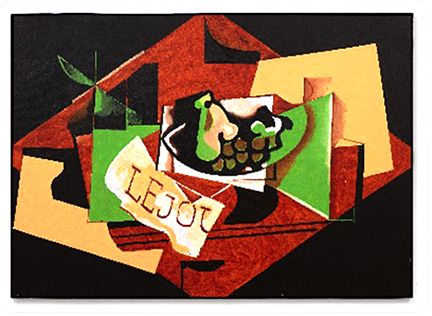
Wilhelm Sasnal
Bez tytułu (według „Martwej natury” Georgesa Braque’a), 2023,
olej na płótnie, drewniana rama, 202,5 x 142,5 cm,
fot. Marek Gardulski, dzięki uprzejmości artysty

Podobnie jest z martwą naturą inspirowaną twórczością Georges’a Braque’a. Rozbite formy, geometryczne podziały i przenikające się perspektywy wnoszą do wnętrza willi niepokój właściwy kubistycznemu spojrzeniu na świat. Obraz wisi nad łóżkiem pani Tobler. Jak wyjaśniał Sasnal w rozmowie z „Apollo Magazine”, kubistyczne rozbicie rzeczywistości miało odzwierciedlać rozpad pozornie uporządkowanego świata rodziny Toblerów. To, co z zewnątrz wydaje się stabilne i harmonijne, kryje wewnętrzne pęknięcia.
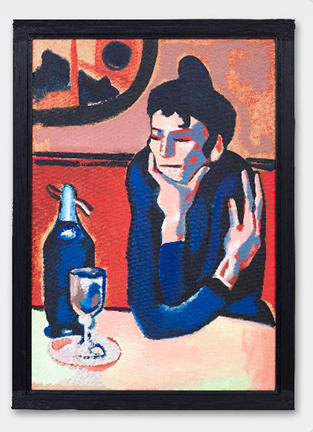
Wilhelm Sasnal
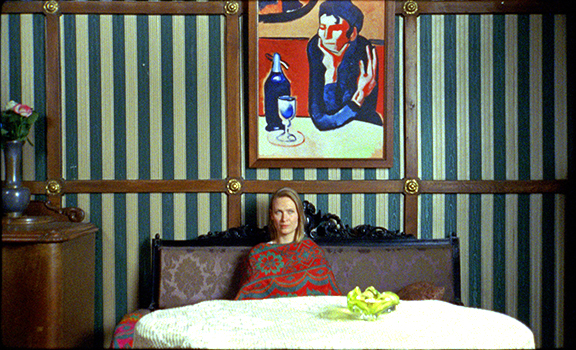
Bez tytułu (według „Pijącej absynt” Pabla Picassa), 2023,
olej na płótnie, drewniana rama, 110 x 80 cm,
fot. Marek Gardulski, dzięki uprzejmości artysty

Wśród obrazów powstałych do filmu znalazła się również interpretacja „Pijącej absynt” Pabla Picassa. W rozmowie z Adamem Szymczykiem Wilhelm Sasnal wspominał, że dobierając kolorystykę tego płótna, starał się oddać samotność pani Tobler. Obraz nie jest więc jedynie cytatem z historii sztuki. Staje się także dyskretnym komentarzem do psychologicznej sytuacji bohaterki.

Spotkanie epok

Dlaczego właśnie Matisse, Picasso i Braque?

Powieść Roberta Walsera ukazała się w 1908 roku, w chwili, gdy europejska sztuka przeżywała jeden ze swoich największych przełomów. Rok wcześniej Picasso namalował „Panny z Awinionu”, zapowiadając narodziny nowego sposobu widzenia i przedstawiania rzeczywistości. Matisse eksperymentował z kolorem, Braque rozbijał przedmioty na geometryczne formy. Malarstwo uwalniało się od obowiązku wiernego naśladowania świata.

Wilhelm Sasnal przywołuje atmosferę tego artystycznego fermentu, nie próbując jednak odtwarzać epoki z muzealną dokładnością. Przeszłość spotyka się tu ze współczesnością, a granice czasu okazują się zaskakująco płynne.

Obok odniesień do awangardy początku XX wieku pojawiają się motywy należące do zupełnie innych dziesięcioleci. W jednej ze scen Joseph Marti wiesza w swoim pokoju obraz Sasnala inspirowany okładką albumu brytyjskiego zespołu The Smiths z 1984 roku. W filmowym świecie znalazło się także miejsce dla wykonanej przez artystę kopii rzeźby Katarzyny Kobro z 1924 roku.
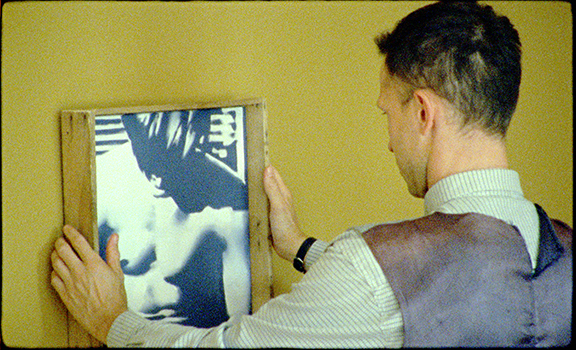
Anka Sasnal i Wilhelm Sasnal „Człowiek do wszystkiego”, 2025 – kadr z filmu.
Joseph Marti wiesza w swoim pokoju obraz W. Sasnala inspirowany okładką albumu brytyjskiego zespołu The Smiths z 1984 r., fot. Marek Gardulski, dzięki uprzejmości artysty.

Powstaje w ten sposób przestrzeń, w której epoki i style przenikają się swobodnie, jak w pamięci, która nie zawsze przestrzega chronologii.

Obrazy mówią również coś o właścicielu willi. Carl Tobler jest człowiekiem ambitnym, przekonanym o własnych możliwościach, pragnącym uchodzić za wynalazcę i człowieka nowoczesnego. Sztuka, którą się otacza, może być świadectwem jego gustu, ale także aspiracji i potrzeby społecznego uznania.

Wnętrze domu staje się więc rodzajem portretu jego mieszkańca. To, co wisi na ścianach, opowiada nie tylko o upodobaniach Toblera, lecz również o tym, za kogo chciałby uchodzić.
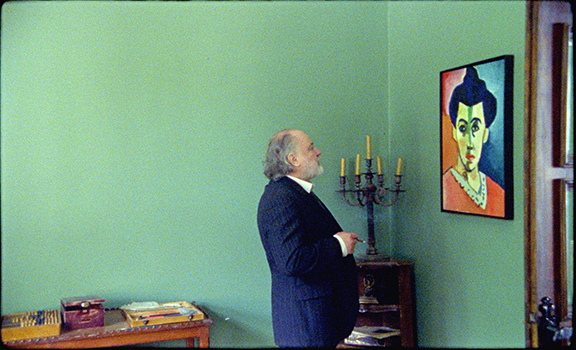
Anka Sasnal i Wilhelm Sasnal „Człowiek do wszystkiego”, 2025 – kadr z filmu, fot. Marek Gardulski, dzięki uprzejmości artysty

Obrazy wychodzą z kadru

Historia tych płócien nie kończy się jednak na filmowym planie.

W 2024 roku, gdy „Człowiek do wszystkiego” pozostawał jeszcze w realizacji, amsterdamskie Stedelijk Museum zaprosiło publiczność na wystawę „Wilhelm Sasnal: Painting as Prop” — „Malarstwo jako rekwizyt”. Jej kuratorem był Adam Szymczyk, polski krytyk sztuki, znany między innymi jako dyrektor artystyczny documenta 14 w Kassel i Atenach.

Wystawa, prezentowana od 30 marca do 1 września 2024 roku, obejmowała 25 obrazów, wśród nich płótna stworzone do filmu, a także inne prace Sasnala, w których powracają historia sztuki, fotografia i pamięć. Projekt wystawy był planowany już podczas pracy nad filmem. Obrazy miały więc od początku szansę zaistnieć zarówno w przestrzeni filmowej, jak i muzealnej.

Sam tytuł wystawy zawierał pewien paradoks. Czy obraz, który powstał jako filmowy rekwizyt, pozostaje tylko rekwizytem? Czy jego znaczenie wyznacza miejsce, dla którego został namalowany?

W filmie obrazy są częścią większej całości. Kamera może zatrzymać się na nich na chwilę albo przesunąć obok, podążając za bohaterami. W muzeum sytuacja się odwraca. To one stają się bohaterami, a widz może poświęcić im tyle czasu, ile zechce.

Historia tych obrazów nie skończyła się wraz z ostatnim klapsem na planie filmowym. Wilhelm Sasnal powrócił do niektórych płócien, poprawiając ich kompozycję, wzmacniając materię malarską, oddalając się od pierwowzorów. W rozmowie z „Apollo Magazine” przyznał, że obrazy powstawały początkowo w pośpiechu, przede wszystkim jako filmowe rekwizyty. Dopiero później poczuł potrzebę nadania im większej głębi i niezależności.

Tak zaczęło się ich drugie życie. Stworzone dla kamery, uwolniły się od jej spojrzenia. W muzealnej przestrzeni nie musiały już towarzyszyć bohaterom ani podporządkowywać się filmowej narracji. Mogły przemawiać własnym językiem — językiem malarstwa.
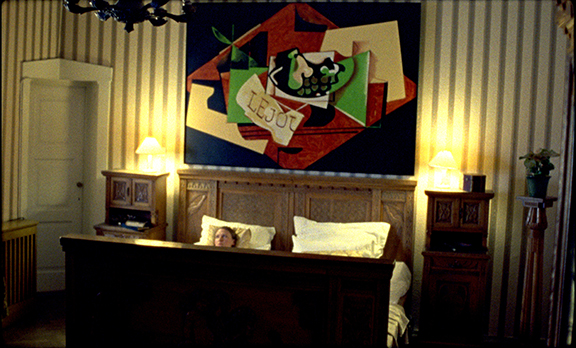
Anka Sasnal i Wilhelm Sasnal „Człowiek do wszystkiego”, 2025 – kadr z filmu, fot. Marek Gardulski, dzięki uprzejmości artysty

Między malarstwem a kinem

Wilhelm Sasnal jest zarówno malarzem, jak i reżyserem, choć sam niechętnie łączy te dwie dziedziny swojej twórczości w jedną. W wywiadach podkreśla ich odmienność. Film to dla niego przede wszystkim opowieść rozwijająca się w czasie, zbudowana z ruchu, wydarzeń i relacji między ludźmi. Malarstwo rządzi się innymi prawami.

A jednak w „Człowieku do wszystkiego” te dwa światy spotykają się w sposób szczególny.

Obrazy nie są jedynie ozdobą wnętrz. Wnoszą do filmu własną historię i znaczenia. Czasem pozostają niemal niezauważone, czasem przyciągają wzrok znajomym motywem lub niespodziewanym zestawieniem barw. Tworzą drugą, dyskretną warstwę opowieści.

Można oglądać losy Josepha Martiego, nie rozpoznając żadnego z malarskich odniesień. Można jednak spojrzeć uważniej i odkryć, że za plecami bohaterów toczy się jeszcze jedna historia — historia sztuki, która nieustannie powraca, zmienia znaczenia i odnajduje się w nowych okolicznościach.

W filmie Anki i Wilhelma Sasnalów malarstwo przekracza granice własnej ramy, by stać się częścią kina. Potem opuszcza ekran i wraca do galerii, już z doświadczeniem innej opowieści.

Bo obraz, nawet namalowany dla filmu, nie musi pozostać w jego cieniu.


Źródła:

  1. Stedelijk Museum, Amsterdam — „Wilhelm Sasnal: Painting as Prop”, wystawa, 30 marca – 1 września 2024.
  2. Rozmowa Wilhelma Sasnala z Adamem Szymczykiem, Stedelijk Museum, 2024.
  3. „The Set Pieces of Wilhelm Sasnal”, Apollo Magazine, 21 marca 2025.
  4. Art Basel — materiały dotyczące malarstwa Wilhelma Sasnala i wystawy w Stedelijk Museum.
  5. Robert Walser, „Der Gehülfe” („Pomocnik”), 1908.


In Search of Memory

Stefan Tompson. Photo: Stefan Tompson’s personal archive.

Joanna Sokołowska-Gwizdka talks with Stefan Tompson — documentary filmmaker, promoter of Polish history, and co-creator, with Patrick Ney, of Covenant of Blood: The Last Soldiers of World War II.

Family Roots

Joanna Sokołowska-Gwizdka: You were born in London, have Polish and British roots, and your family history also extends to South Africa. What was your upbringing like?

Stefan Tompson: My father is British, from South Africa. His family has lived there since the early nineteenth century. He left South Africa in the 1980s. On my mother’s side, I’m Polish. She, too, was born in the West. We grew up across several cultures: we spoke Polish with our mother and English with our father, and we attended French schools.

You speak Polish without a noticeable foreign accent. Who do you have to thank for that?

My mother. She put an enormous amount of effort into it. Polish was the language of our home, and we also attended Polish Saturday schools. Before 2004, those schools were primarily places where the children of wartime émigrés and those who had left Poland during the Solidarity era came together. These communities had strong ties to Poland and were firmly anti-communist. Later waves of immigration changed that community considerably.

Why did the Polish side of your family go into exile?

Stefan Tompson: They didn’t leave for economic reasons. There were Polish diplomats in the family, and the war, followed by communism, meant they couldn’t return. When the war broke out, my grandmother was staying at the family estate near Lwów. By 1940, she was in London. My grandfather was a diplomat in Brazil and later ended up in Britain as well.

Is there a story passed down in your family that captures that experience of exile particularly well?

There’s a story about my grandmother. After the war, my grandfather bought her some flower seeds. My grandmother, who had grown up on an estate with vast stretches of land, said she had never imagined that one day she wouldn’t have enough soil to fill a pot and plant some flowers.

To me, that story captures the fate of people who grew up in prosperity and then found themselves in exile with almost nothing. In London, they recreated their world: they established Polish institutions, clubs, schools, and parishes. There were organizations such as Ognisko Polskie and POSK, the Polish Social and Cultural Association. A whole network of families knew one another and kept their connection to Poland alive.

How much of that world has survived in your generation?

A great deal has changed. What pains me most is the loss of the language and the connection to Poland in successive generations. Among the people I know, there are few families like ours, in which those born in the West still speak Polish fluently. That makes me appreciate my mother’s efforts all the more.

I also look at the later waves of emigration. Poles are very hardworking and enterprising. I saw educated people arrive in Britain and take jobs far below their qualifications. There is dignity in all work, but it was difficult to see their potential going to waste. Many eventually became financially secure and joined the British middle class. From Poland’s perspective, though, the question remains: how many will return, and what connection to the country will their children retain?

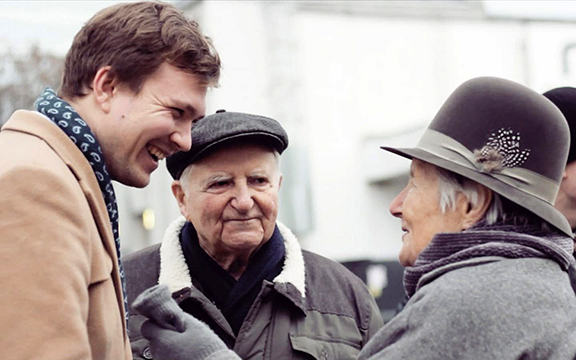
Jakub Nowakowski, codename “Tomek,” and Daniela Ogińska, codename “Pszczoła.” Photo: Stefan Tompson’s personal archive.
Returning to the Land of My Ancestors

When and why did you decide to settle in Poland?

In 2015. I was 22 at the time. As I mentioned, my family hadn’t ended up in Britain by choice. After the war, they wanted to return and help rebuild Poland, but that wasn’t possible. I felt that, now that Poland was a free country, I could live and work there, pay taxes, and build businesses. I also wanted to start a family and raise my children in Poland.

I still spend a lot of time in South Africa and other African countries, where we also have clients. But I wanted to make Poland my home and contribute to its development.

You say “I returned,” even though you were born in London.

Strictly speaking, it wasn’t a return to my birthplace. But across the generations, that is how I see it: as bringing my family’s forced exile to an end. I came with my brother, and my sister later moved here too. Of the four of us siblings, three now live in Poland. Our parents also spend part of the year here.

I’m very happy with that decision. I can see how Poland is developing. It also meant a great deal to me that I arrived in time to get to know many veterans, Warsaw Uprising participants, and members of the anti-communist underground. In 2015–2016, I spent a lot of time with them.

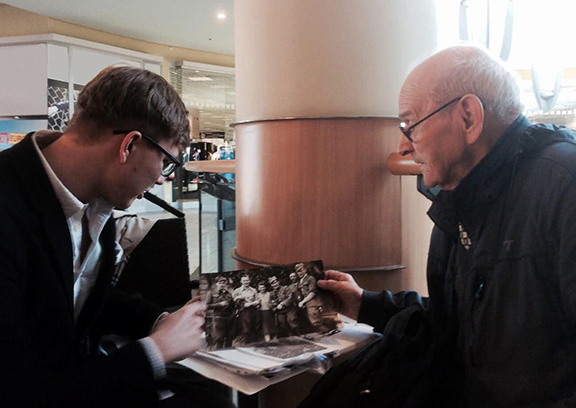
Stefan Tompson with Józef Bandzo, codename “Jastrząb.” Photo: Stefan Tompson’s personal archive.
Family History and Film

Did your interest in communism and the people who resisted it stem from your family’s experiences?

Absolutely. Communism was the reason our family wasn’t in Poland. Two of my grandfather’s brothers were murdered at Katyń. So my relationship with that system is deeply personal.

I see its consequences on several levels: in the murder of people and the destruction of the country’s elites, in the loss of economic potential, but also in the destruction of a sense of beauty. I look at prewar architecture, at the cities and what Poles managed to create despite the partitions. Then I see the grayness and uniformity imposed by communism. To me, those wounds are still visible, not only in Poland but also in other countries across Central and Eastern Europe.

Did that desire to tell the story of life under communism lead to Covenant of Blood: The Last Soldiers of World War 2, the film about Poland’s postwar underground resistance that you co-directed with Patrick Ney, a Briton fascinated by Polish history?

Yes, but paying tribute to the people who actually fought against that ideology was just as important. Earlier, I made a film called Oni budowali nasze szczęście (“They Built Our Happiness”), about entrepreneurs working under communist rule in Poland, including private market gardeners. It was a tribute to the unsung heroes of small business who tried to make a living despite the system.

With the film about the soldiers of the anti-communist resistance, I felt this was our last chance to reach the surviving witnesses. It was also important to me to tell their story in English. I wanted people who don’t have access to Polish-language material to learn about their sacrifice and courage.

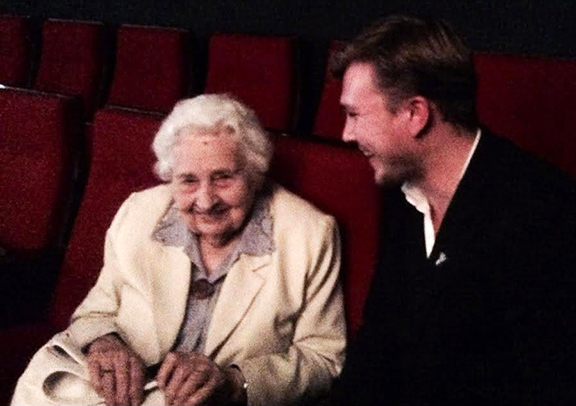
Stefan Tompson with Maria Mirecka-Loryś. Photo: Stefan Tompson’s personal archive.

You speak of a debt to these people. What does that debt mean to you?

Above all, it is a moral debt. There were people who not only refused to take part in the system but chose to fight it, risking everything. I think of Hieronim Dekutowski, Łukasz Ciepliński, August Emil Fieldorf, Witold Pilecki, and Zygmunt Szendzielarz and his soldiers. Their lives took different paths, and their forms of resistance varied, but they shared a willingness to make sacrifices.

I also see a continuity of resistance that later found expression in workers’ protests, opposition activism, and the Solidarity movement. Through this film, I wanted to repay my own debt to the soldiers of the anti-communist resistance.

Who is the film intended for?

Two groups. The first is people of Polish descent who no longer speak Polish but are interested in their roots. The second is international audiences interested in Poland and the experience of communism.

In the West, the story of Solidarity and the strikes at the Gdańsk Shipyard is well known. Far fewer people know about those who took up armed resistance after the war. We wanted to tell that chapter of the story too.

Patrick Ney. Photo: press materials.
Collaboration and Personal Encounters

How did you meet Patrick Ney, and what brought you together?

We met online about ten years ago. We were both making short films and conducting interviews, telling stories about Poland in English. Over time, a close friendship developed. We’re very fond of each other and have great respect for one another.

Patrick has no Polish roots. He met a Polish woman and moved first to Wrocław, then to Warsaw. He started a family here and joined the Territorial Defence Forces. To me, he is an example of someone who not only fell in love with Poland but became Polish. He found tradition, faith, and common sense here — things that can also draw people from other countries.

Which of your encounters with veterans have stayed with you most vividly?

I was friends with Józef Bandzo, codename “Jastrząb,” a soldier who served under Zygmunt Szendzielarz, known as “Łupaszka.” He spent sixteen years in communist prisons. I interviewed him for one of my earliest, still very amateur films, W poszukiwaniu ojczyzny (“In Search of a Homeland”). I was 22 at the time.

I asked the veterans what Poles were like. Bandzo replied, “Poles are good. Poles are a good people.” I often return to those words. I think of goodness, truth, and beauty as interconnected values. That simple answer has stayed with me ever since.

Stefan Tompson with Józef Bandzo, codename “Jastrząb.” Photo: Stefan Tompson’s personal archive.

Whose story moves you most deeply today?

Since becoming a father to a daughter, I see Inka’s story differently (Danuta Siedzikówna, a Home Army medic sentenced to death in 1946 as part of the communist regime’s campaign of repression — editor’s note). I knew her story before, but fatherhood has changed the way I experience it. I think of that seventeen-year-old girl and her words to her grandmother: “I behaved as I should.” Those words move me deeply.

I would like to raise my daughter to have that same moral backbone. To me, Inka’s story embodies a healthy Polish patriotism: an understanding that there are values you cannot abandon under pressure. I also think of her family, who lost so much, and of the grandmother to whom she addressed those words.

What do you think the people in these stories have in common?

Extraordinary courage. I am moved by people who knew how overwhelmingly powerful their enemy was and yet chose to fight. I think, for instance, of Zdzisław Badocha, codename “Żelazny,” and the photographs of that young, smiling man. I also think of the tragic fate of Józef Kuraś, known as “Ogień,” and the recollections of his soldiers.

What moves me most is their willingness to give everything, including their lives. I felt that when I recorded my conversations with the veterans, and it has stayed with me ever since.


W poszukiwaniu pamięci

Stefan Tompson, fot. arch. Stefana Tompsona
Rodzinne korzenie

Joanna Sokołowska-Gwizdka: Urodziłeś się w Londynie, masz polskie i brytyjskie korzenie, a historia rodziny prowadzi także do Republiki Południowej Afryki. Jak wyglądało twoje wychowanie?

Stefan Tompson: Mój ojciec jest Brytyjczykiem z Południowej Afryki. Jego rodzina mieszka tam od początku XIX wieku. Wyjechał z RPA w latach osiemdziesiątych XX w. Ze strony mamy jestem Polakiem. Ona również urodziła się na Zachodzie. Wychowywaliśmy się w kilku kulturach: z mamą rozmawialiśmy po polsku, z ojcem po angielsku, a chodziliśmy do francuskich szkół.

Mówisz po polsku bez wyraźnego obcego akcentu. Komu to zawdzięczasz?

Mamie. Włożyła w to ogromną ilość wysiłku. Język polski był językiem naszego domu, chodziliśmy też do polskich szkół sobotnich. Przed 2004 rokiem były one przede wszystkim miejscem spotkań dzieci emigracji wojennej i solidarnościowej. To były środowiska mocno związane z Polską i antykomunistyczne. Późniejsza emigracja bardzo zmieniła tę społeczność.

Dlaczego polska część twojej rodziny znalazła się na emigracji?

Stefan Tompson: Nie był to wyjazd zarobkowy. W rodzinie byli polscy dyplomaci, a wojna i późniejszy komunizm sprawiły, że nie mogli wrócić. Moja babcia w chwili wybuchu wojny przebywała w rodzinnym majątku pod Lwowem. W 1940 roku była już w Londynie. Dziadek był dyplomatą w Brazylii, potem również trafił do Wielkiej Brytanii.

Czy zachowała się w rodzinie opowieść, która szczególnie dobrze oddaje doświadczenie tej emigracji?

Jest taka historia o babci. Po wojnie dziadek kupił jej nasiona kwiatów. Babcia, która wychowała się w majątku z rozległymi połaciami ziemi, powiedziała wtedy, że nigdy nie przypuszczała, iż zabraknie jej ziemi do doniczki, żeby posadzić kwiaty.

Dla mnie ta opowieść bardzo dobrze oddaje los ludzi, którzy dorastali w dobrobycie, a później znaleźli się na emigracji niemal bez niczego. W Londynie odtwarzali swój świat: powstawały polskie instytucje, kluby, szkoły i parafie. Działały Ognisko Polskie i POSK. Istniał cały ekosystem rodzin, które się znały i podtrzymywały więź z krajem.

Co z tego świata pozostało w twoim pokoleniu?

Bardzo wiele się zmieniło. Boli mnie przede wszystkim utrata języka i więzi z Polską w kolejnych pokoleniach. Wśród ludzi, których znam, niewiele jest rodzin takich jak nasza, w których osoby urodzone na Zachodzie nadal swobodnie mówią po polsku. Tym bardziej doceniam wysiłek mamy.

Patrzę też na późniejszą emigrację. Polacy są bardzo pracowici i przedsiębiorczy. Widziałem ludzi wykształconych, którzy po przyjeździe do Wielkiej Brytanii podejmowali pracę znacznie poniżej kwalifikacji. Żadna praca nie hańbi, ale trudno mi było patrzeć na niewykorzystany potencjał tych osób. Wielu z nich z czasem się dorobiło i weszło do brytyjskiej klasy średniej. Z perspektywy Polski pozostaje jednak pytanie, ilu z nich wróci i jaką więź z krajem zachowają ich dzieci.

Jakub Nowakowski, pseudonim „Tomek” i Daniela Ogińska, pseudonim „Pszczoła”, fot, arch. Stefana Tompsona
Powrót do kraju przodków

Kiedy i dlaczego zdecydowałeś się zamieszkać w Polsce?

W 2015 roku. Miałem wtedy 22 lata. Jak już mówiłem, moja rodzina nie znalazła się w Wielkiej Brytanii z wyboru. Po wojnie chcieli wrócić i budować Polskę, ale nie było to możliwe. Uznałem, że skoro dziś istnieje wolne państwo, mogę w nim żyć, pracować, płacić podatki i tworzyć firmy. Chciałem również założyć rodzinę i wychować dzieci w Polsce.

Nadal spędzam dużo czasu w RPA i w innych krajach Afryki, gdzie mamy także klientów. Ale zależało mi na tym, żeby związać życie z Polską i uczestniczyć w jej rozwoju.

Mówisz „wróciłem”, chociaż urodziłeś się w Londynie.

Technicznie to nie jest powrót do miejsca urodzenia. W wymiarze pokoleniowym właśnie tak to jednak rozumiem: jako zakończenie wymuszonej rodzinnej tułaczki. Przyjechałem z bratem, później zamieszkała tu także moja siostra. Z naszej czwórki rodzeństwa troje jest dziś w Polsce. Rodzice również spędzają tutaj część roku.

Bardzo się cieszę z tej decyzji. Widzę, jak Polska się rozwija. Ważne było dla mnie także to, że zdążyłem poznać wielu kombatantów, powstańców i uczestników antykomunistycznego podziemia. W latach 2015–2016 spędzałem z nimi dużo czasu.

Stefan Tompson z Józefem Bandzo, pseudonim „Jastrząb”, fot. arch. Stefana Tompsona
Historia rodzinna i film

Czy zainteresowanie komunizmem i ludźmi, którzy mu się przeciwstawiali, wynikało z rodzinnych doświadczeń?

Zdecydowanie tak. To przez komunizm naszej rodziny nie było w Polsce. Dwóch braci mojego dziadka zamordowano w Katyniu. Mój stosunek do tego systemu jest więc bardzo osobisty.

Widzę jego skutki w kilku wymiarach: w zamordowaniu ludzi i zniszczeniu elit, w utracie potencjału gospodarczego, ale też w zniszczeniu poczucia piękna. Patrzę na przedwojenną architekturę, na miasta i na to, co Polacy potrafili stworzyć mimo zaborów. Potem widzę szarość i ujednolicenie narzucone przez komunizm. Dla mnie te rany są nadal widoczne, nie tylko w Polsce, lecz także w innych krajach Europy Środkowo-Wschodniej.

Czy z potrzeby opowiedzenia o doświadczeniu komunizmu wyrósł film o powojennym podziemiu „Covenant of Blood: The Last Soldiers of World War 2”, który wyreżyserowaliście wspólnie z Patrickiem Neyem, Brytyjczykiem zafascynowanym polską historią?

Tak, ale równie ważne było oddanie hołdu ludziom, którzy rzeczywiście z tą ideologią walczyli. Wcześniej zrobiłem film „Oni budowali nasze szczęście” o przedsiębiorcach działających w czasach PRL, między innymi o badylarzach. Był to hołd dla bohaterów drobnej przedsiębiorczości, którzy próbowali działać mimo systemu.

Przy filmie o żołnierzach niezłomnych miałem poczucie, że to ostatni moment, żeby dotrzeć do żyjących świadków. Zależało mi również na opowiedzeniu tej historii po angielsku. Chciałem, żeby o ich poświęceniu i odwadze dowiedzieli się ludzie, do których polskojęzyczne materiały nie docierają.

Stefan Tompson z Marią Mirecką-Loryś, fot. arch. Stefana Tompsona

Mówisz o długu wobec tych ludzi. Na czym on polega?

To przede wszystkim dług moralny. Byli ludzie, którzy nie tylko odmówili udziału w systemie, ale zdecydowali się z nim walczyć, ryzykując wszystko. Myślę o Hieronimie Dekutowskim, Łukaszu Cieplińskim, Auguście Emilu Fieldorfie, Witoldzie Pileckim czy Zygmuncie Szendzielarzu i jego żołnierzach. Ich losy były różne, podobnie jak formy oporu, ale łączyła ich gotowość do poświęcenia.

Widzę w tym także ciągłość sprzeciwu, który później wyrażał się w protestach robotniczych, działalności opozycji i Solidarności. Tym filmem chciałem spłacić własny dług wobec żołnierzy niezłomnych.

Do kogo kierujecie film?

Do dwóch grup. Pierwszą są ludzie polskiego pochodzenia, którzy nie mówią już po polsku, ale interesują się swoimi korzeniami. Drugą są zagraniczni widzowie zainteresowani Polską i doświadczeniem komunizmu.

Na Zachodzie znana jest historia Solidarności i strajków w Stoczni Gdańskiej. Znacznie mniej osób wie o tych, którzy po wojnie podjęli zbrojny opór. Chcieliśmy pokazać również ten rozdział.

Patrick Ney, fot. mat. prasowe
Współpraca i osobiste spotkania

Jak poznałeś Patricka Neya i co was połączyło?

Poznaliśmy się przez Internet około dziesięciu lat temu. Obaj robiliśmy krótkie filmy i wywiady, opowiadając po angielsku o Polsce. Z czasem powstała bliska przyjaźń. Bardzo się lubimy i cenimy.

Patrick nie ma polskich korzeni. Związał się z Polką, zamieszkał najpierw we Wrocławiu, później w Warszawie. Założył tu rodzinę i dołączył do Wojsk Obrony Terytorialnej. Dla mnie jest przykładem człowieka, który nie tylko pokochał Polskę, ale stał się Polakiem. Dostrzegł w niej tradycję, wiarę i zdrowy rozsądek — rzeczy, które potrafią przyciągać także ludzi z zewnątrz.

Które ze spotkań z kombatantami szczególnie zapamiętałeś?

Przyjaźniłem się z Józefem Bandzo, ps. „Jastrząb”, żołnierzem Zygmunta Szendzielarza „Łupaszki”. Spędził szesnaście lat w komunistycznych więzieniach. Rozmawiałem z nim przy jednym z moich pierwszych, jeszcze bardzo amatorskich filmów — „W poszukiwaniu ojczyzny”. Miałem wtedy 22 lata.

Pytałem kombatantów, jacy są Polacy. Bandzo odpowiedział: „Polacy są dobrzy. Polacy to jest dobry naród”. Często wracam do tego zdania. Myślę o dobru, prawdzie i pięknie jako wartościach, które są ze sobą związane. Ta prosta odpowiedź bardzo mocno we mnie została.

Stefan Tompson z Józefem Bandzo, pseudonim „Jastrząb”, fot. arch. Stefana Tompsona

A czyja historia porusza cię dziś najbardziej?

Odkąd mam córkę, inaczej patrzę na historię Inki (Danuty Siedzikówny, sanitariuszki Armii Krajowej, w 1946 roku skazanej na śmierć w ramach komunistycznego aparatu represji — przyp. red.). Znałem ją wcześniej, ale ojcostwo zmieniło mój sposób jej przeżywania. Myślę o siedemnastoletniej dziewczynie i o słowach skierowanych do babci: „zachowałam się jak trzeba”. To zdanie bardzo mnie wzrusza.

Chciałbym wychować córkę w taki sposób, żeby miała podobny kręgosłup moralny. Dla mnie historia Inki uosabia zdrowy polski patriotyzm: świadomość, że są wartości, których nie można się wyrzec pod presją. Myślę też o jej rodzinie, która tak wiele straciła, i o babci, do której kierowała te słowa.

Co łączy według ciebie bohaterów tych opowieściach?

Niesamowita odwaga. Porusza mnie postawa ludzi, którzy mieli świadomość ogromnej przewagi przeciwnika, a mimo to podejmowali walkę. Myślę choćby o Zdzisławie Badosze „Żelaznym”, o zdjęciach tego młodego, uśmiechniętego człowieka. Myślę też o tragicznych losach Józefa Kurasia „Ognia” i o wspomnieniach jego żołnierzy.

Najbardziej wzrusza mnie gotowość oddania wszystkiego, łącznie z własnym życiem. To czułem, kiedy nagrywałem rozmowy z kombatantami, i to nadal we mnie pozostaje.


A Censored Work. The Extraordinary Story Behind the Poster for Andrzej Wajda’s Film „Man of Marble”.

Joanna Sokołowska-Gwizdka

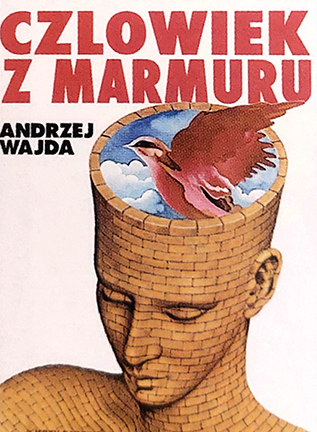
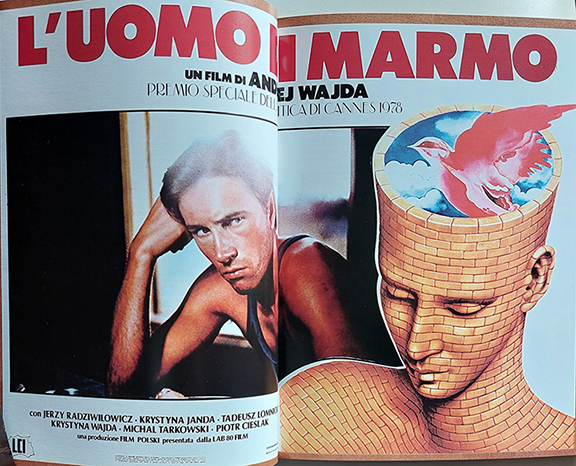
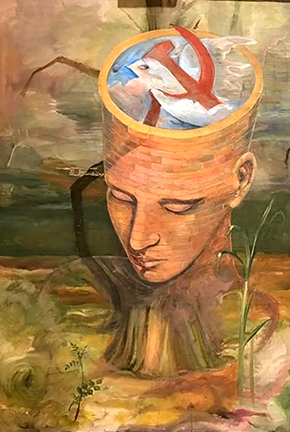
One of the Italian posters for Andrzej Wajda’s Man of Marble conceals a story far larger than the history of the film itself. It begins with a painting by Franco Scepi depicting a man whose head is built like a brick wall, from which a dove emerges together with the hammer and sickle. Then the symbols of communism disappear. Nearly twenty years later, in a handwritten letter to the artist, Andrzej Wajda would write: “I persuaded you at the time to change the concept and censored the work.” And the image, born in the 1970s, would begin an entirely new life as Man of Peace — a symbol associated with Mikhail Gorbachev and Nobel Peace Prize laureates.

Franco Scepi, poster design for Andrzej Wajda’s Man of Marble, 1978. In this version, the hammer and sickle have disappeared, while the bird emerging from the open brick-built head remains. Photo courtesy of Franco Scepi.
When I approached the Italian artist Franco Scepi to ask permission to display his poster for Man of Marble in an exhibition being prepared for the Austin Polish Film Festival, I expected a brief answer: yes or no.

Permission came. But with it, I received something I had not expected at all.

Franco Scepi sent photographs, documentation tracing the successive incarnations of his work, and a copy of a handwritten letter from Andrzej Wajda. He wrote that he wanted to share a story he considered very important and one that, in his view, is not widely known in Poland. He had created the poster at Andrzej Wajda’s request in 1978.

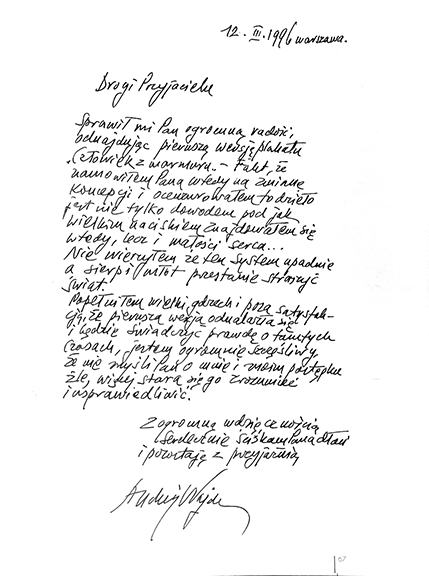
The most remarkable item, however, was a one-page letter dated March 12, 1996, handwritten by Andrzej Wajda to Franco Scepi. It begins with the words: “Dear Friend.”

Andrzej Wajda writes that he was immensely pleased that the first version of the poster for Man of Marble had been rediscovered. Then comes a sentence one would hardly expect: “At the time, I persuaded you to change the concept and censored the work.”

The director does not shift responsibility onto some anonymous “censorship.” He writes in the first person. He adds that his decision was evidence not only of the pressure he was under at the time, but also — as he himself puts it — of his “smallness of heart.” He admits that he did not believe the communist system would ever collapse or that the hammer and sickle would cease to “haunt the world.”

It is an extraordinary testimony. Not because it reveals the existence of censorship in communist Poland — we know that all too well. What is extraordinary is that, nearly twenty years later, one of Poland’s most distinguished film directors returned to a single decision concerning a poster and described his own conduct without constructing an exculpatory narrative around it.

There is something profoundly human in this letter: the memory of fear, an awareness of compromise, and relief that the original version of the work survived.

Handwritten letter from Andrzej Wajda to Franco Scepi, Warsaw, March 12, 1996. In it, the director revisits the history of the first version of the poster for Man of Marble and writes about his decision to alter the concept of the work. Photo courtesy of Franco Scepi.

A Head Made of Brick

Franco Scepi’s first painting is unsettling. A human head rises from the ground, built like a wall of bricks. The skull is open. Inside it, against a background of sky, are the hammer and sickle, intertwined with the movement of a white bird.

Franco Scepi recalls that the painting was created in 1977 and that its inspiration was connected with Kraków and the then Archbishop of Kraków, Karol Wojtyła. Today, a monumental version of the work is housed at Museo MAGI ’900.

In 1978, the artist created a design based on the same motif. A year later, he returned to it when preparing the Italian poster for Andrzej Wajda’s Man of Marble. But something had changed. The hammer and sickle had disappeared.

On the L’uomo di marmo poster, the man built of bricks remains. His head is still open to the sky, but now only the bird emerges from within. The hammer and sickle are gone.

If we had only the two images, one might wonder whether this was an aesthetic decision, a change in composition, or an intervention by the Italian distributor. The 1996 letter removes that uncertainty. It was Andrzej Wajda who asked Franco Scepi to change the concept. And years later, Wajda himself described that intervention as censorship.

There is an extraordinary paradox in this story, because Man of Marble is itself one of the most important Polish films about the manipulation of truth by the communist system.

Aleksander Ścibor-Rylski’s screenplay had been written many years earlier, but for a long time it could not be produced because of censorship. The film follows Agnieszka, a young film-school student who tries to reconstruct the fate of Mateusz Birkut — a model worker created by Stalinist propaganda and later erased from official memory.

A film about uncovering the truth beneath a propagandistic image therefore received a poster from which the director himself — under pressure from the political system — persuaded the artist to remove the system’s most direct symbol.

It would be hard to imagine a more ironic commentary on the realities of communist Poland.

Franco Scepi, Italian poster for Andrzej Wajda’s L’Uomo di Marmo (Man of Marble), 1979. The poster notes the critics’ award presented to the film at the Cannes Film Festival in 1978. Photo courtesy of Franco Scepi.

Birkut Built of Bricks

Franco Scepi’s poster is also an exceptionally apt interpretation of the film. Mateusz Birkut is a bricklayer. Propaganda constructs him almost literally out of bricks: production records, newsreels, speeches, and a carefully staged image of the “new man.” In Franco Scepi’s work, the man himself becomes a wall.

There is no conventional portrait of the actor. The face no longer belongs only to Birkut. It is more universal, almost anonymous. The wall encloses the man, yet it is precisely in his head that a space opens through which one can escape. The dove flying upward can be read as freedom, thought, truth — something that cannot be completely walled in.

The first version, however, was more overtly political. The bird was not merely escaping confinement: it was carrying the hammer and sickle away with it.

In 1978, Man of Marble was shown at the Cannes Film Festival and received the FIPRESCI Prize, awarded unanimously by the International Federation of Film Critics. Franco Scepi’s Italian poster belongs to this period.

The film began its international life. As it would turn out, Franco Scepi’s image did as well.

Franco Scepi, original version of L’Uomo della Pace (Man of Peace), 1977. From the open brick-built head emerge a dove and the hammer and sickle. Photo courtesy of Franco Scepi.

The First Version Returns

In 1996, the first, unused version of the work was rediscovered. For Andrzej Wajda, it must have been an encounter with his own past. In his letter to Franco Scepi, he writes that he is pleased not only that the painting has been found, but also that it will be able to “bear witness to the truth about those times.”

The words that follow are even more moving. Andrzej Wajda thanks the artist for not judging his conduct at the time solely as an act of cowardice, but for trying to understand it. The letter ends warmly — with gratitude, a handshake, and an assurance of friendship.

At this point, the history of the poster ceases to be a simple story of “artist versus censor.” Andrzej Wajda himself was operating within the system: negotiating, yielding, and trying to get his films made. Man of Marble, after all, was a film he had waited many years to bring to the screen.

His letter reveals a mechanism far subtler than an official’s red stamp: self-censorship born of an awareness of the boundaries whose violation could have jeopardized the entire undertaking. It also reveals the psychological cost of such decisions, still remembered twenty years later.

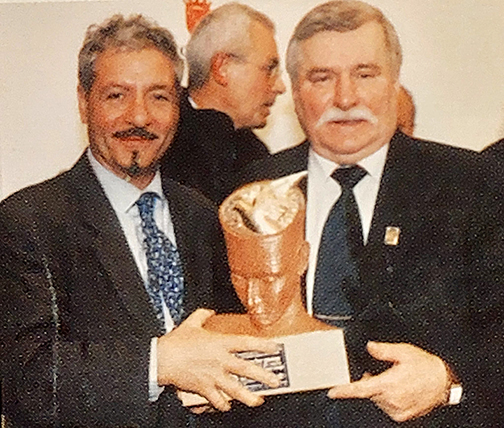
Presentation of Franco Scepi’s Man of Peace statuette to Lech Wałęsa, 2001. Miniature versions of the work were presented to Nobel Peace Prize laureates and to individuals particularly engaged in efforts for peace. Photo courtesy of Franco Scepi.

From Man of Marble to Man of Peace

The story could have ended there, but it did not. The motif of the man with a wall-like head reappeared in Franco Scepi’s work under the name L’Uomo della Pace – Man of Peace.

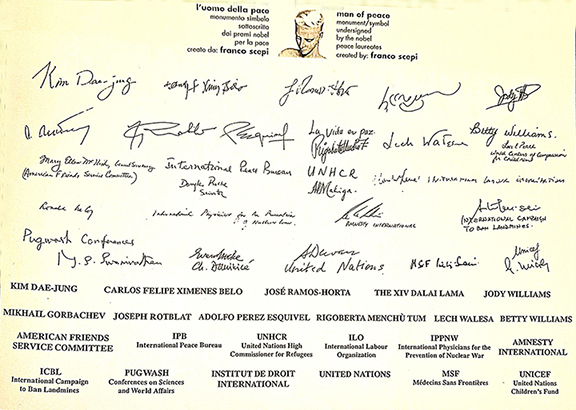
In the 1990s, the work became associated with initiatives led by Mikhail Gorbachev and the World Summit of Nobel Peace Laureates. In 1999, the image was signed in Rome by Nobel Peace Prize laureates, including Mikhail Gorbachev, Lech Wałęsa, the 14th Dalai Lama, Rigoberta Menchú, José Ramos-Horta, Jody Williams, Adolfo Pérez Esquivel, and Betty Williams, as well as representatives of organizations that had received the Nobel Peace Prize.

The signatures of these laureates appear beneath the work. Representatives of organizations awarded the Nobel Peace Prize also signed it, including the United Nations, Amnesty International, UNHCR, UNICEF, the International Labour Organization, and Médecins Sans Frontières.

The symbol whose communist meaning had been softened on the film poster in the 1970s thus returned, after the collapse of that system, in an entirely new context.

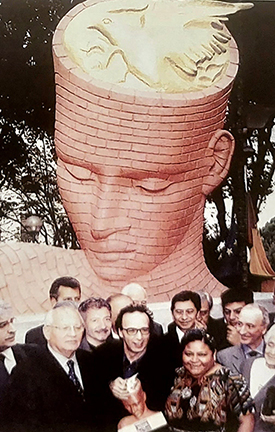
Monumental versions of Man of Peace were created. One of them is housed at Museo MAGI ’900 in Pieve di Cento, where a separate section of the collection is devoted to the work. Its history leads from the 1977 painting, through the poster for Andrzej Wajda’s film, to a symbol of peace associated with Mikhail Gorbachev.

According to Franco Scepi, this transformation is precisely what gives the work its particular significance: an image inspired by the experience of communism and by the dream of transcending political walls came, many years later, to function among people who had taken part in the peaceful ending of the Cold War.

Monumental version of Franco Scepi’s L’Uomo della Pace (Man of Peace) during an event associated with the World Summit of Nobel Peace Laureates, Rome, 2002. Photo courtesy of Franco Scepi.

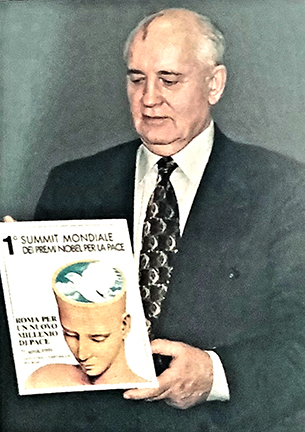
Mikhail Gorbachev with material devoted to the World Summit of Nobel Peace Laureates, featuring the motif of Franco Scepi’s L’Uomo della Pace (Man of Peace), 2004. Photo courtesy of Franco Scepi.

The Letter Matters Most

One can admire the later monuments. One can trace the signatures of Nobel laureates. One can tell the story of Gorbachev, Wojtyła, Andrzej Wajda, and the extraordinary journey of a single image through the final decades of the twentieth century. For me, however, the most valuable document remains a single sheet of paper: Andrzej Wajda’s letter. It contains something far rarer than political declarations: an artist’s acknowledgment of his own compromise.

Andrzej Wajda does not write from the perspective of someone who knew from the beginning that communism was bound to collapse. On the contrary. He admits that at the time he did not believe it would. That sentence changes the perspective.

It is easy to look back at the past knowing how it ended. It is far more difficult to remember what the future looked like to someone living within a system that seemed permanent.

In 1978, the hammer and sickle disappear from the poster.

In 1989, the Berlin Wall falls.

In 1996, Andrzej Wajda looks at the rediscovered original image and writes to Franco Scepi that he had never imagined the system would truly pass away. And the image of the man built of bricks lives on.

That is perhaps the most beautiful paradox of this story: the version that once could not be shown ultimately survived as a witness to its time. Exactly as Andrzej Wajda had hoped.

Card bearing the signatures of Nobel Peace Prize laureates and representatives of organizations honored with the prize beneath the symbol of Franco Scepi’s L’Uomo della Pace (Man of Peace), Rome, 1999. The signatures include, among others, Mikhail Gorbachev, Lech Wałęsa, the 14th Dalai Lama, Rigoberta Menchú, José Ramos-Horta, Jody Williams, and Betty Williams. Photo courtesy of Franco Scepi.
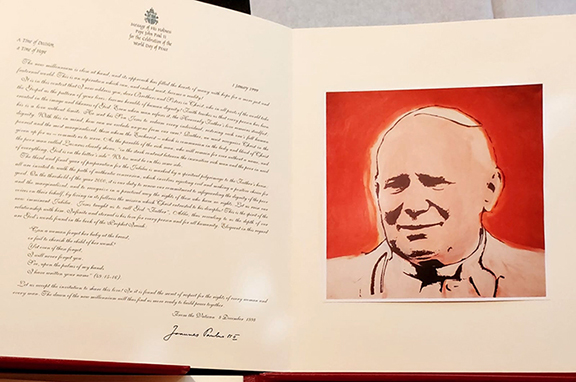
Message of Pope John Paul II for the 32nd World Day of Peace, January 1, 1999, featuring a portrait of the Pope. The document is entitled “Respect for Human Rights: The Secret of True Peace.” Photo courtesy of Franco Scepi.
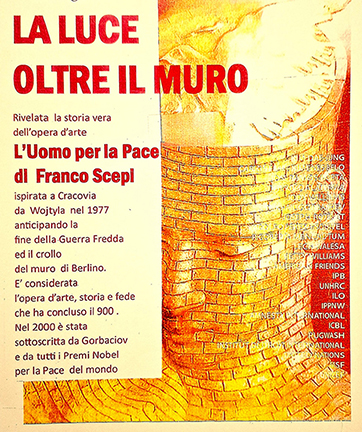
“La luce oltre il muro” (“The Light Beyond the Wall”) — material devoted to the history of Franco Scepi’s L’Uomo per la Pace (Man of Peace) and its connections with Karol Wojtyła, the end of the Cold War, and Nobel Peace Prize laureates, 2026. Photo courtesy of Franco Scepi.
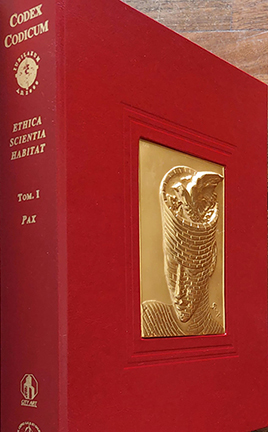
Codex Codicum. Ethica Scientia Habita, Vol. I: Pax, 1999. The cover features the motif of Franco Scepi’s L’Uomo della Pace (Man of Peace). Photo courtesy of Franco Scepi.
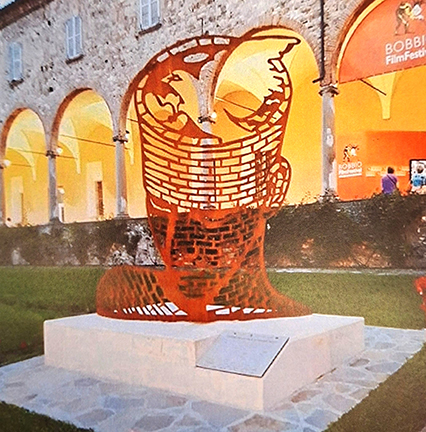
Franco Scepi, L’Uomo della Pace (Man of Peace), monumental double-sided version of the sculpture installed in front of the Abbey of San Colombano in Bobbio, 2017. The work was unveiled with the participation of Nobel Peace Prize laureate David Trimble. Photo courtesy of Franco Scepi.
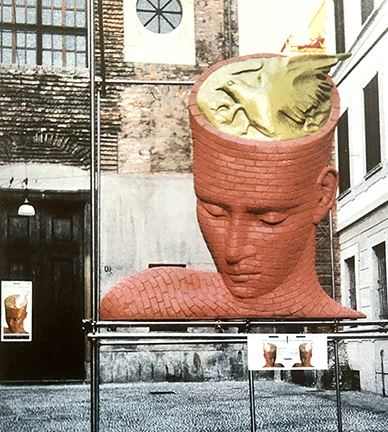
Monumental version of Franco Scepi’s L’Uomo della Pace (Man of Peace), 2003. The motif, originating in the 1977 painting and in the poster for Andrzej Wajda’s Man of Marble, later took on an independent life as a symbol of peace. Photo courtesy of Franco Scepi.


On Alex Storozynski’s film „Kosciuszko: A Man Before His Time”

Alex Storozynski — journalist, author, and filmmaker; author of „The Peasant Prince: Thaddeus Kosciuszko and the Age of Revolution” and writer-director of the documentary „Kosciuszko: A Man Before His Time„. Photo courtesy of Alex Storozynski / storozynski.com.

Joanna Sokołowska-Gwizdka

Years ago, I watched a documentary about Tadeusz Kościuszko whose title I no longer remember. The filmmakers traveled to the American town of Kosciusko, Mississippi, and asked people on the street whether they knew who the man was whose name their town bears. One response stayed with me in particular. Someone was astonished to learn that Kościuszko was Polish. All their life, they had assumed he was Native American.

Years later, that scene came back to me while I was watching Alex Storozynski’s documentary Kosciuszko: A Man Before His Time. Kościuszko’s name is, after all, inscribed in the American landscape: towns, counties, streets, bridges, schools, and mountains bear his name, and monuments to him stand in many places across the United States. And yet the man behind that name remains surprisingly little known to many Americans.

American filmmaker, photographer, and writer Floyd Webb, who was born in Mississippi, has described an almost identical experience. He passed through the town of Kosciusko many times while visiting family or traveling between Mississippi and Chicago. The town’s name seemed entirely natural to him, as if it had simply always been there. Yet no one had ever told him where it came from. Only many years later, during visits to Warsaw and Kraków, did Polish friends tell him about Tadeusz Kościuszko. Webb then realized that he had known Kościuszko’s name all his life — first from Mississippi, later from the monument in Chicago — without knowing the man himself. As he observed, sometimes history stands in plain sight before us for an entire lifetime before we truly begin to see it.

A Journalist Fascinated by a Polish Hero

Alex Storozynski was born in New York City in 1961 into a family of Polish immigrants. He grew up in Brooklyn and Queens. His father, Dionizy, came from Lwów, while his mother, Irena, was from Volhynia. Polish history was therefore present in his home from childhood. As a boy, he accompanied his father to gatherings of Polish veterans, where portraits of Pulaski and Kościuszko hung on the walls.

He graduated from the State University of New York at New Paltz and later from Columbia University’s Graduate School of Journalism. He went on to build a distinguished career in American journalism. He was a member of the editorial board of the New York Daily News, the founding editor-in-chief of the free daily newspaper amNewYork, and city editor of The New York Sun. In 1999, the editorial board of the New York Daily News, of which he was a member, received the Pulitzer Prize for its campaign to save Harlem’s legendary Apollo Theater.

For many years he has also been associated with The Kosciuszko Foundation in New York. In 2008 he became its president and executive director, and he currently serves as chairman of its Board of Trustees.

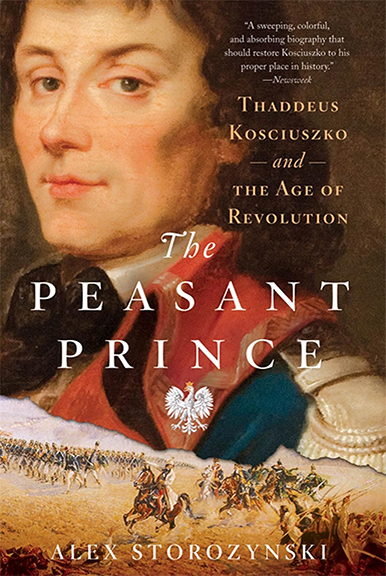
Tadeusz Kościuszko, however, became much more to him than the patron of a Polish-American institution. Storozynski spent around ten years working on his biography, researching archives, correspondence, and accounts left by people who had known the Polish commander. In 2009, The Peasant Prince: Thaddeus Kosciuszko and the Age of Revolution was published in the United States and later appeared in Polish as Kościuszko. Książę chłopów. The biography received, among other distinctions, the Fraunces Tavern Museum Book Award.

What fascinated Alex Storozynski above all was how different the real man behind the textbook monument was from the simplified image of a national hero.

Alex Storozynski’s book about Tadeusz Kościuszko

A Man Before His Time

The documentary Kosciuszko: A Man Before His Time was made in 2015. Storozynski wrote the screenplay and directed the film, which was based on his book. American actor Blair Underwood served as narrator, while Olek Krupa provided the voice of Kościuszko. Filming took place in Saratoga, West Point, Philadelphia, and Poland, among other locations. Historians appear in the film, as does Zbigniew Brzezinski. The documentary was broadcast by PBS stations in the United States.

The title of the film is key to the way Alex Storozynski tells the story of his subject. He is interested not only in Kościuszko the general, military engineer, hero of Saratoga, and designer of the fortifications at West Point. Above all, he asks what the word freedom meant to Kościuszko.

Kościuszko lived in a world that was not ready for his ideas. He understood freedom as a right that should not belong only to society’s privileged classes. He thought about peasants, townspeople, Jews, women, and, in America, Black people as well.

Before Kościuszko became a hero of two continents, however, he was a young man whose life was changed by an unfulfilled love.

Ludwika Sosnowska

After graduating from Warsaw’s School of Chivalry and spending time in France, Kościuszko returned to Poland but was unable to find a position in the army. He became tutor to the daughters of Józef Sosnowski, Field Hetman of Lithuania. One of them was Ludwika Sosnowska.

The young teacher and his pupil fell in love. Ludwika was well educated and interested in new economic ideas, including physiocracy, which also fascinated Kościuszko. Alex Storozynski points out that the two were connected not only by affection but also by a similar way of thinking about society.

Ludwika’s father, however, had no intention of giving his daughter in marriage to an impoverished nobleman without great wealth or social standing. Kościuszko and Ludwika attempted to elope, but their plan failed. Ludwika later became the wife of Prince Józef Aleksander Lubomirski.*

Kościuszko left Poland. Before long, he found himself on the other side of the Atlantic, where a revolution was beginning that would change the world.

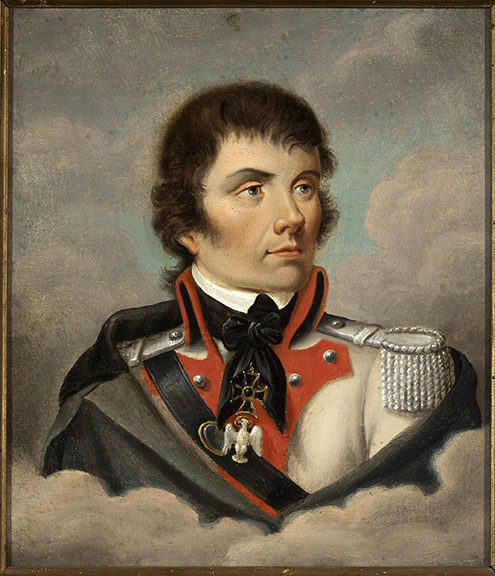
Tadeusz Kościuszko, artist unknown, National Museum in Warsaw, public domain

1776 — The Birth of America

Kościuszko arrived in America in the year the Declaration of Independence was proclaimed. In October 1776, Congress appointed him a colonel and engineer in the Continental Army.

His talent became particularly evident during the Saratoga campaign. It was Kościuszko who selected and prepared the American defensive positions at Bemis Heights, making brilliant use of the terrain.

Later, Tadeusz Kościuszko was entrusted with building a system of fortifications at West Point on the Hudson River, a strategically crucial location whose loss could have divided the rebellious colonies in two. He created fortifications that helped make West Point one of the most important defensive strongholds of the young nation.

Kościuszko was therefore one of the people who helped make the creation of the United States possible.

Freedom — But for Whom?

It is here that the most contemporary aspect of Alex Storozynski’s story begins. The American Revolution proclaimed the equality of human beings, while at the same time the new republic remained a society built to a considerable extent on slavery.

Kościuszko recognized this contradiction.

In 1798, before leaving the United States once again, Kościuszko drew up an extraordinary will. He entrusted his American estate to Thomas Jefferson and instructed that the money be used to purchase the freedom of enslaved people and to provide them with vocational training and the means to begin independent lives.

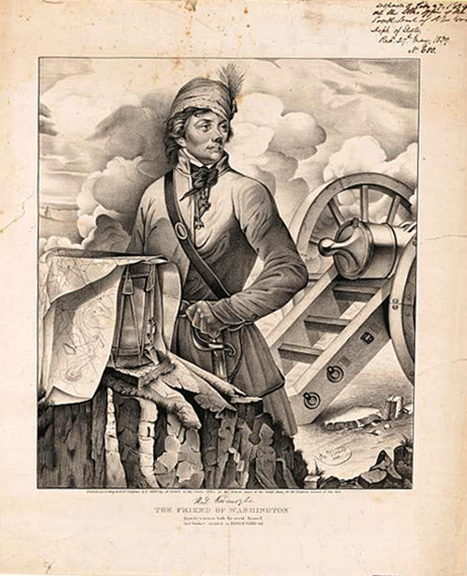
Tadeusz Kościuszko, Friend of Washington, A. Girard, ca. 1839. Photo: Library of Congress, Prints and Photographs Division, public domain.

Return to Poland

Kościuszko returned to Europe as a hero of the American War of Independence. Several years later, he became the leader of the 1794 uprising in Poland.

Here, too, his understanding of independence extended beyond the interests of the nobility. After the victory at Racławice, he put on a peasant’s homespun coat, while the Proclamation of Połaniec limited the personal subjugation of peasants and reduced the compulsory labor obligations of those who took part in the uprising. Kościuszko attempted to create a political community broader than the traditional noblemen’s Polish-Lithuanian Commonwealth.

This is why Alex Storozynski describes him as a man before his time. Not because every modern concept of human rights can simply be attributed to him, but because, against the background of the eighteenth century, he consistently sought to broaden the circle of people entitled to freedom.

Not a Monument, but a Man

Alex Storozynski’s film is at its most compelling when it allows us to see Kościuszko not as a bronze monument but as a human being — first as a young man in love with Ludwika, a talented draftsman and engineer; later as an emigrant who set out for another continent without yet knowing that he would find himself at the center of one of the most important events of the eighteenth century; an officer who built his career through talent rather than wealth or birth.

Above all, however, we see a man who persistently asked an uncomfortable question:

If we demand freedom for ourselves, can we deny it to others?

Perhaps this is precisely why Kościuszko fascinated Alex Storozynski so deeply.

250 Years Later

In 2026, Kościuszko’s story takes on an additional significance. The United States is celebrating the 250th anniversary of the Declaration of Independence, while the year also marks the 280th anniversary of Tadeusz Kościuszko’s birth.

Floyd Webb, who for decades passed through Kosciusko, Mississippi, and by the Kościuszko monument in Chicago before learning who the man behind the name actually was, has written that history can preserve names while quietly setting aside the ideas that once gave those names meaning.

Alex Storozynski’s film attempts to restore both. Not only Kościuszko’s name, but also the man behind it.

____________________

Note:

*While working on my master’s thesis, The Castle Theater in the Residence of the Lubomirski and Potocki Families in Łańcut, I was examining archival materials preserved at Łańcut Castle when I came across the memoirs of Teofil Bauman, the son of Fryderyk Bauman, an architect and stucco artist who worked at Łańcut for Princess Marshal Izabela Lubomirska.

There I found the story of how, during a visit to the Lubomirski family in Równe, Princess Marshal became so enchanted with their young son Henryk that she decided to take him with her. She hid the child in a large fur muff and drove away with him, informing his parents only afterward.

It turned out that the boy’s mother was Ludwika Sosnowska, Tadeusz Kościuszko’s beloved, who, as the wife of Józef Lubomirski, gave birth to their son in 1777. In letters to her mother, Ludwika complained of how deeply she missed her child, but eventually it was agreed that Henryk would remain with Princess Marshal, who provided him with the finest education and upbringing available at the time.

__________

Sources:

  1. Alex Storozynski, The Peasant Prince: Thaddeus Kosciuszko and the Age of Revolution, Thomas Dunne Books/St. Martin’s Press, New York, 2009.
  2. Alex Storozynski, Kosciuszko: A Man Before His Time, documentary film, 2015.
  3. U.S. National Park Service, Saratoga National Historical Park — “Tadeusz Kosciuszko.” Biography. Tadeusz Kosciuszko – National Park Service
  4. Library of Congress — “Our Founding Uncle, Thaddeus K.” Materials on Kościuszko’s role in the American Revolution and his will. Our Founding Uncle, Thaddeus K. – Library of Congress
  5. Polish History — Kościuszko – a man before his time, Interview with Alex Storozynski.
  6. The Kosciuszko Foundation — materials on Alex Storozynski’s activities, his journalistic career, his book on Kościuszko, and his work with The Kosciuszko Foundation. The Kosciuszko Foundation – Mission and History
  7. Floyd Webb — “An Opportunity to Mean It,” 2026. A personal reflection by the American filmmaker. An Opportunity to Mean It


O filmie Alexa Storożyńskiego „Kościuszko. Człowiek, który wyprzedził swoją epokę”

Alex Storożyński — dziennikarz, pisarz i filmowiec, autor książki „The Peasant Prince: Thaddeus Kosciuszko and the Age of Revolution” oraz scenarzysta i reżyser filmu dokumentalnego „Kosciuszko: A Man Before His Time„, fot. dzięki uprzejmości Alexa Storożyńskiego / storozynski.com.

Joanna Sokołowska-Gwizdka

Przed laty oglądałam film dokumentalny o Tadeuszu Kościuszce, którego tytułu dziś już nie pamiętam. Autorzy pojechali do amerykańskiego miasteczka Kosciusko w stanie Mississippi i pytali przypadkowych mieszkańców, czy wiedzą, kim był człowiek, którego nazwisko nosi ich miejscowość. Szczególnie zapamiętałam jedną z wypowiedzi. Ktoś ze zdumieniem dowiedział się, że Kościuszko był Polakiem. Przez całe życie był przekonany, że był Indianinem.

Po latach ta scena wróciła do mnie podczas oglądania dokumentu Alexa Storożyńskiego „Kosciuszko: A Man Before His Time”. Nazwisko Kościuszki jest przecież wpisane w amerykański krajobraz: noszą je miasta, hrabstwa, ulice, mosty, szkoły i góry, a jego pomniki stoją w wielu miejscach Stanów Zjednoczonych. A jednak człowiek, który kryje się za tym nazwiskiem, jest dla wielu Amerykanów zaskakująco mało znany.

Amerykański filmowiec, fotograf i pisarz Floyd Webb, urodzony w Mississippi, opisał niemal identyczne doświadczenie. Wielokrotnie przejeżdżał przez miejscowość Kosciusko, odwiedzając rodzinę lub podróżując z Mississippi do Chicago. Nazwa miasta była dla niego czymś oczywistym, istniejącym od zawsze. Nikt jednak nie powiedział mu, skąd się wzięła. Dopiero wiele lat później, podczas pobytów w Warszawie i w Krakowie, polscy znajomi opowiedzieli mu o Tadeuszu Kościuszce. Webb uświadomił sobie wtedy, że przez całe życie znał jego nazwisko — z Mississippi, później z pomnika w Chicago — ale nie znał człowieka. Jak napisał: historia czasami stoi przed nami na widoku przez całe życie, zanim zaczniemy ją naprawdę dostrzegać

Dziennikarz zafascynowany polskim bohaterem

Alex Storożyński urodził się w 1961 roku w Nowym Jorku w rodzinie polskich emigrantów. Wychował się na Brooklynie i Queensie. Jego ojciec Dionizy pochodził ze Lwowa, matka Irena z Wołynia. Historia Polski była więc obecna w jego domu od dzieciństwa. Jako chłopiec chodził z ojcem na spotkania polskich weteranów, gdzie na ścianach wisiały portrety Pułaskiego i Kościuszki.

Ukończył State University of New York at New Paltz, a następnie Graduate School of Journalism na Columbia University. Zrobił znaczącą karierę w amerykańskiej prasie. Był członkiem zespołu redakcyjnego „New York Daily News”, pierwszym redaktorem naczelnym bezpłatnego dziennika „amNewYork” oraz city editor „The New York Sun”. W 1999 roku zespół redakcyjny „New York Daily News”, którego był członkiem, otrzymał Nagrodę Pulitzera za kampanię na rzecz uratowania legendarnego Apollo Theatre na Harlemie.

Od lat jest związany z nowojorską The Kosciuszko Foundation. W 2008 roku został jej prezesem i dyrektorem wykonawczym, obecnie jest przewodniczącym Rady Powierniczej.

Tadeusz Kościuszko stał się jednak dla niego czymś więcej niż patronem polonijnej instytucji. Pracował nad jego biografią około dziesięciu lat, docierając do archiwów, korespondencji i świadectw ludzi, którzy znali Naczelnika. W 2009 roku ukazała się w Stanach Zjednoczonych książka „The Peasant Prince: Thaddeus Kosciuszko and the Age of Revolution”, później wydana po polsku jako „Kościuszko. Książę chłopów”. Biografia otrzymała m.in. Fraunces Tavern Museum Book Award.

Alexa Storożyńskiego fascynowało przede wszystkim to, jak bardzo człowiek ukryty za podręcznikowym pomnikiem różni się od uproszczonego obrazu narodowego bohatera.

Książka Alexa Storożyskiego o Tadeuszu Kościuszce

Człowiek, który wyprzedził swoją epokę

Dokument „Kosciuszko: A Man Before His Time”  powstał w 2015 roku. Dziennikarz napisał scenariusz i wyreżyserował film oparty na swojej książce. Narratorem został amerykański aktor Blair Underwood, głosu Kościuszce użyczył Olek Krupa, a zdjęcia realizowano m.in. w Saratodze, West Point, Filadelfii i w Polsce. W filmie wypowiadają się historycy oraz Zbigniew Brzeziński. Dokument był emitowany przez stacje PBS w Stanach Zjednoczonych.

Tytuł filmu jest kluczem do sposobu, w jaki Alex Storożyński opowiada o swoim bohaterze. Nie interesuje go wyłącznie Kościuszko — generał, inżynier wojskowy, bohater Saratogi i twórca fortyfikacji West Point. Pyta przede wszystkim, co dla Kościuszki oznaczało słowo wolność.

Kościuszko żył w świecie nieprzygotowanym na jego idee. Wolność rozumiał jako prawo nie tylko uprzywilejowanych warstw społeczeństwa. Myślał o chłopach, mieszczanach, Żydach, kobietach, a w Ameryce również o czarnoskórych.

Zanim jednak Kościuszko został bohaterem dwóch kontynentów, był młodym człowiekiem, którego los zmieniła niespełniona miłość.

Ludwika Sosnowska

Po ukończeniu warszawskiej Szkoły Rycerskiej i pobycie we Francji Kościuszko wrócił do kraju, ale nie znalazł dla siebie miejsca w wojsku. Został nauczycielem córek hetmana polnego litewskiego Józefa Sosnowskiego. Jedną z nich była Ludwika Sosnowska.

Między młodym nauczycielem i uczennicą narodziło się uczucie. Ludwika była dobrze wykształcona i interesowała się nowymi ideami ekonomicznymi, między innymi fizjokratyzmem, który fascynował także Kościuszkę. Alex Storożyński zwraca uwagę na to, że łączyło ich nie tylko uczucie, lecz także podobny sposób myślenia o społeczeństwie.

Ojciec Ludwiki nie zamierzał jednak oddać córki niezamożnemu szlachcicowi bez wielkiego majątku i pozycji. Kościuszko i Ludwika próbowali uciec, lecz plan się nie powiódł. Ludwika została później żoną księcia Józefa Aleksandra Lubomirskiego*.

Kościuszko wyjechał z Polski. Wkrótce znalazł się po drugiej stronie Atlantyku, gdzie rozpoczynała się rewolucja, która miała zmienić świat.

Tadeusz Kościuszko, autor nieznany, Muzeum Narodowe w Warszawie, domena publiczna

1776 – narodziny Ameryki

Kościuszko przybył do Ameryki w roku ogłoszenia Deklaracji Niepodległości. W październiku 1776 roku Kongres mianował go pułkownikiem i inżynierem Armii Kontynentalnej.

Jego talent ujawnił się szczególnie podczas kampanii pod Saratogą. To Kościuszko wybrał i przygotował amerykańskie pozycje obronne na Bemis Heights, znakomicie wykorzystując ukształtowanie terenu.

Później Tadeuszowi Kościuszce powierzono budowę systemu fortyfikacji w West Point nad rzeką Hudson, w strategicznym miejscu, którego utrata mogła przeciąć zbuntowane kolonie na dwie części. Stworzył fortyfikacje, dzięki którym miejsce to stało się jednym z najważniejszych punktów obronnych młodego państwa.

Kościuszko był więc jednym z ludzi, którzy pomogli wywalczyć powstanie Stanów Zjednoczonych.

Wolność — ale dla kogo?

I właśnie tutaj zaczyna się najbardziej współczesna część historii opowiadanej przez Alexa Storożyńskiego. Amerykańska rewolucja głosiła, że wszyscy ludzie są równi, a jednocześnie nowa republika pozostawała społeczeństwem opartym w znacznej mierze na niewolnictwie. Kościuszko tę sprzeczność dostrzegał.

W 1798 roku, przed ponownym opuszczeniem Stanów Zjednoczonych, Kościuszko sporządził niezwykły testament. Powierzył swój amerykański majątek Thomasowi Jeffersonowi i polecił przeznaczyć pieniądze na wykupienie niewolników i zapewnienia im zdobycia zawodu oraz możliwości rozpoczęcia samodzielnego życia.

Tadeusz Kościuszko, przyjaciel Waszyngtona, A. Girard, ok. 1839, fot. Library of Congress, Prints and Photographs Division, domena publiczna

Powrót do Polski

Kościuszko wrócił do Europy jako bohater amerykańskiej wojny o niepodległość. Kilkanaście lat później stanął na czele insurekcji 1794 roku.

Także tutaj jego rozumienie niepodległości wykraczało poza interesy szlachty. Po zwycięstwie pod Racławicami przywdział chłopską sukmanę, a Uniwersał Połaniecki ograniczał poddaństwo chłopów i zmniejszał pańszczyznę tych, którzy uczestniczyli w powstaniu. Kościuszko próbował stworzyć wspólnotę polityczną szerszą niż tradycyjna Rzeczpospolita szlachecka.

Dlatego Alex Storożyński nazywa go człowiekiem wyprzedzającym swój czas. Nie dlatego, że można bez zastrzeżeń przypisać mu wszystkie współczesne pojęcia praw człowieka, lecz dlatego, że na tle XVIII wieku konsekwentnie poszerzał krąg ludzi, którym przysługiwać miała wolność.

Nie pomnik, lecz człowiek

Film Alexa Storożyńskiego jest najciekawszy właśnie wtedy, kiedy pozwala zobaczyć Kościuszkę nie jako spiżowy pomnik, lecz jako człowieka – najpierw młodego mężczyznę zakochanego w Ludwice, utalentowanego rysownika i inżyniera, potem emigranta, który wyruszył na drugi kontynent, nie wiedząc jeszcze, że znajdzie się w centrum jednego z najważniejszych wydarzeń XVIII wieku, oficera, który zrobił karierę dzięki talentowi, nie dzięki pochodzeniu czy majątkowi. A przede wszystkim człowieka konsekwentnie zadającego niewygodne pytanie: jeżeli domagamy się wolności dla siebie, czy możemy odmawiać jej innym? I może właśnie dlatego Kościuszko tak bardzo zainteresował Alexa Storożyńskiego.

250 lat później

W 2026 roku historia Kościuszki nabiera dodatkowego znaczenia. Stany Zjednoczone obchodzą 250-lecie Deklaracji Niepodległości, a jednocześnie przypada 280. rocznica urodzin Tadeusza Kościuszki.

Floyd Webb, który przez dziesięciolecia mijał miejscowość Kosciusko w Mississippi i pomnik Kościuszki w Chicago, zanim dowiedział się, kim był ich bohater, napisał, że historia potrafi zachować nazwiska, a po cichu odłożyć na bok idee, które nadawały im znaczenie.

Film Alexa Storożyńskiego próbuje przywrócić jedno i drugie. Nie tylko nazwisko Kościuszki, lecz także człowieka, który za nim stoi.


Przypisy:

  • Pisząc pracę magisterską „Teatr Zamkowy w rezydencji Lubomirskich i Potockich w Łańcucie”, przeglądając zachowane w zamku archiwalia, trafiłam na pamiętnik Teofila Baumana, syna Fryderyka Baumana, architekta i sztukatora pracującego dla Lubomirskich. Opisane tam jedno z wydarzeń przykuło moja uwagę. Otóż Księżna Marszałkowa podczas pobytu u rodziny Lubomirskich w Równem zachwyciła się ich dzieckiem, małym Henrykiem, do tego stopnia, że postanowiła go zabrać. Ukryła dziecko w wielkiej futrzanej mufce i wyjechała z nim, a dopiero później zawiadomiła rodziców. Okazało się, że matką chłopca była Ludwika Sosnowska, ukochana Tadeusza Kościuszki, która jako żona Józefa Lubomirskiego urodziła mu syna w 1777 r. Ludwika w listach do matki skarżyła się na tęsknotę za synem. Ostatecznie jednak ustalono, że Henryk zostanie z Księżną Marszałkową, która zresztą zapewniła mu najlepsze wykształcenie i wychowanie, jakie można było wtedy zdobyć.

Źródła:

  1. Alex Storożyński, The Peasant Prince: Thaddeus Kosciuszko and the Age of Revolution, Thomas Dunne Books/St. Martin’s Press, New York 2009.
  2. Alex Storożyński, Kosciuszko: A Man Before His Time, film dokumentalny, 2015.
  3. U.S. National Park Service, Saratoga National Historical Park – „Tadeusz Kosciuszko”. Biografia. Tadeusz Kosciuszko – National Park Service
  4. Library of Congress – „Our Founding Uncle, Thaddeus K.” Materiały dotyczące udziału Kościuszki w rewolucji amerykańskiej oraz jego testamentu. Our Founding Uncle, Thaddeus K. – Library of Congress
  5. Polish History – „Kościuszko – a man before his time”. Wywiad z Alexem Storożyńskim. Kościuszko – a man before his time
  6. The Kosciuszko Foundation – materiały dotyczące działalności Alexa Storożyńskiego, jego kariery dziennikarskiej, książki o Kościuszce oraz pracy w Fundacji Kościuszkowskiej. The Kosciuszko Foundation – Mission and History
  7. Floyd Webb – „An Opportunity to Mean It”, 2026. Osobista refleksja amerykańskiego filmowca. An Opportunity to Mean It


The Many Faces of Film. Austin Polish Film Festival 2026.

Polish cinema in its many forms, conversations with filmmakers, an exhibition of posters for Andrzej Wajda’s films, and a closing piano concert — these are the highlights of the 21st Austin Polish Film Festival, which this year celebrates the 250th anniversary of the United States.

Design: Patrycja Longawa

Joanna Sokołowska-Gwizdka

When Tadeusz Kościuszko arrived in America in 1776, the young republic’s independence was still a promise that had to be fought for. Two and a half centuries later, his story will return to the screen in Austin, opening a broader exploration of Polish contributions to American life and world culture. This year’s Austin Polish Film Festival will spotlight people whose knowledge, talent, and imagination transcended borders, languages, and generations.

The festival’s 21st edition will take place November 5–8 and 15, 2026. Feature films and documentaries, a poster exhibition, conversations with guests, and a closing concert will weave together a multifaceted story of Polish-American ties. The main film events will be held at AFS Cinema, 6259 Middle Fiskville Road in Austin.

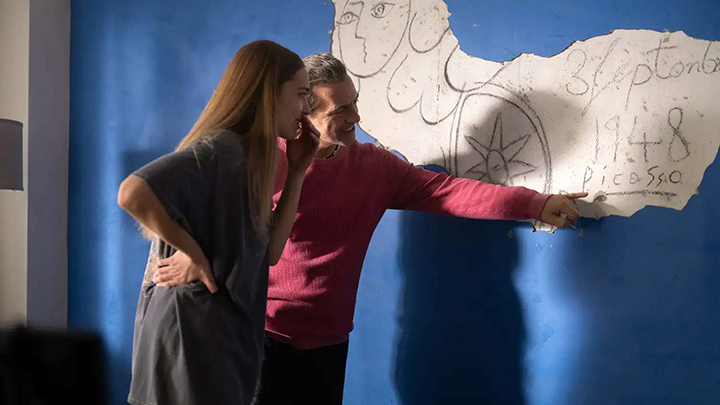
Picasso’s Mermaid (2026), directed by Janusz Zaorski. Photo: Jarosław Sadkowski, press materials.

Gala: From Kościuszko to Picasso

The gala on Friday, November 6, beginning at 6:30 p.m. with a reception featuring Polish cuisine, will include Alex Storozynski’s documentary about Tadeusz Kościuszko. The Polish military engineer arrived in Philadelphia in August 1776, just weeks after the adoption of the Declaration of Independence. His expertise in fortifications helped the Americans secure victory at Saratoga; he was later entrusted with fortifying West Point. A hero of the American Revolutionary War and later the leader of an uprising in Poland, Kościuszko linked the destinies of both nations through his life’s work.

The gala will also feature Janusz Zaorski’s Picasso’s Mermaid, a comic tale inspired by a true episode from Pablo Picasso’s visit to postwar Warsaw. A mermaid drawn on an apartment wall sets the stage for an extraordinary encounter between great art and everyday life. After the screening, audiences will join the director for a conversation about the film, its inspirations, and finding humor in unexpected situations.

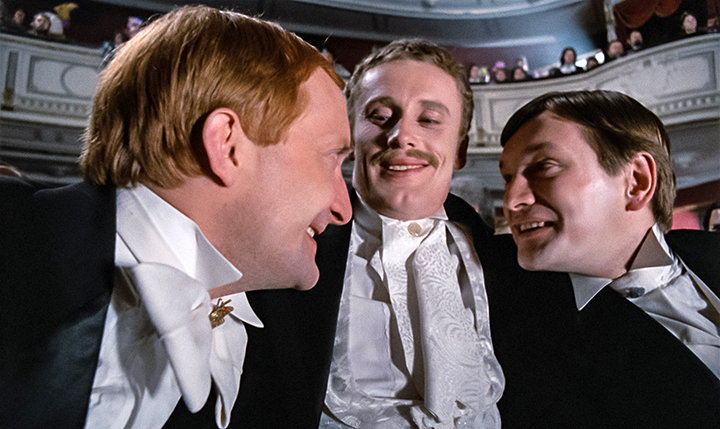
The Promised Land (1974), directed by Andrzej Wajda. Images courtesy of WFDiF / 35mm.online.

Wajda: A Polish Experience, a Universal Language

Andrzej Wajda will hold a special place in the program as we celebrate the centenary of his birth this year. Rooted in Polish history, literature, and painting, his cinema spoke to audiences around the world. Through his characters’ lives, he explored difficult choices, the tension between dreams and reality, and individual responsibility in the face of history. On March 26, 2000, he received an honorary Oscar in recognition of five decades of extraordinary film direction.

The festival’s opening evening will be dedicated to Wajda. On Thursday, November 5, an exhibition of posters for his films will open at 6:30 p.m., followed by a screening of The Promised Land at 7:30 p.m. The posters will offer a fresh perspective on his work through the imagination of artists who translated its dramatic intensity into metaphor, symbol, and color.

This adaptation of Władysław Reymont’s novel will transport audiences to nineteenth-century Łódź — a city of factory chimneys, burgeoning fortunes, and ambitions that come at a steep price. The sweeping scope and painterly power of The Promised Land remain captivating, while its questions about the limits of compromise and the cost of success continue to resonate.

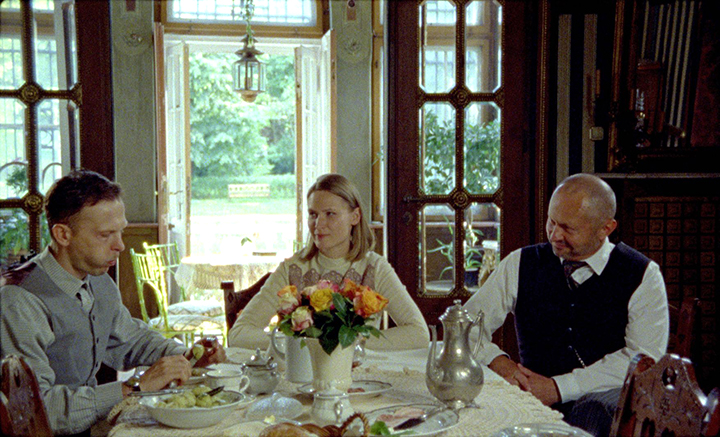
The Assistant, directed by Anka and Wilhelm Sasnal. Photo: press materials.

Literature Through the Lens of Cinema

Literary worlds will also come to life in The Doll, directed by Maciej Kawalski, and The Assistant by Anka and Wilhelm Sasnal, an adaptation of Robert Walser’s novel. Alongside the works of Prus and Reymont, the Swiss writer’s story will offer another perspective on individuals caught up in social hierarchies, financial dependencies, and the desire to change their fortunes.

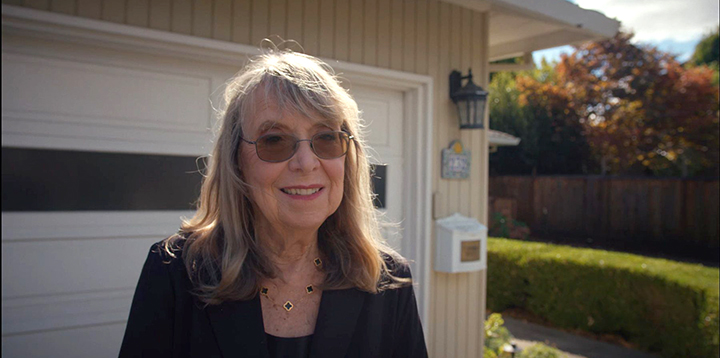
The Sasnals’ film will also introduce audiences to a creative duo whose work brings together literature, painting, and cinema. Wilhelm, one of Poland’s most internationally recognized contemporary painters, brings a visual artist’s sensibility to their filmmaking; Anka, a director and screenwriter with a background in Polish literary studies, helps shape their distinctive cinematic language. The connection between the arts is particularly close here: paintings Sasnal created for The Assistant were also exhibited at the Stedelijk Museum in Amsterdam. After the screening, audiences will have the opportunity to speak with Piotr Trojan, who plays the title role.

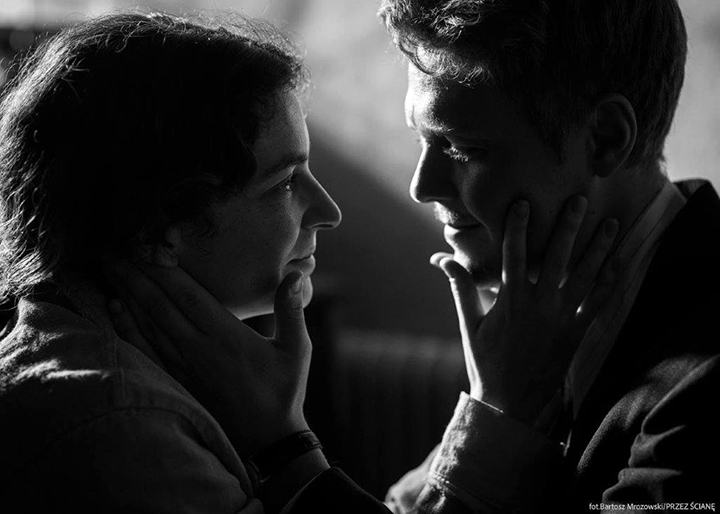
Through the Wall, directed by Maciej Sobieszczański. Photo: WFDiF.


From History to the Present

Among the historical films, a highlight will be Through the Wall by Maciej Sobieszczański, winner of the Golden Lions at this year’s Polish Film Festival in Gdynia. Inspired by the true experiences of prisoners during the Stalinist era, the film explores the strength of a bond forged in a world of violence and isolation.

Broadening this historical perspective is Covenant of Blood: The Last Soldiers of World War II by Patrick Ney and Stefan Tompson, a documentary about Poland’s anti-communist underground resistance. Both films remind us that the end of the war did not mean freedom for everyone. Stefan Tompson will travel to Austin to meet with audiences after the screening.

Meanwhile, Altar Boys, There Are No Ghosts on Dobra Street, and Memories of Insignificance will turn our attention to social tensions, family relationships, and the search for meaning. In these films, seriousness meets humor, rebellion encounters helplessness, and the longing for closeness confronts the difficulty of connecting with others. This is cinema that leaves room for viewers’ own emotions and questions.

Esther Wojcicki. Photo: press materials.

The Wojcicki Family: Silicon Valley’s Polish Roots

On Saturday, November 7, at 2:30 p.m., we will screen The Godmother of Silicon Valley — a documentary about Esther Wojcicki, a teacher who helped generations of students develop independence, creativity, and the courage to think for themselves.

Polish experiences resonate deeply within this American story. Esther’s husband, Stanley Wojcicki, born Stanisław Jerzy Wójcicki, was a distinguished physicist, professor, and chair of Stanford University’s physics department. As a boy, he fled communist Poland with his mother and brother, reaching the United States via Sweden. His father remained in Poland, where he was imprisoned for political reasons.

Esther and Stanley’s three daughters made their mark in different fields: Susan helped build Google’s success and led YouTube for many years; Anne co-founded the genetic testing company 23andMe; and Janet devoted her career to anthropology, epidemiology, and research into children’s health. Their family’s story weaves the experience of immigration together with a belief in education and the ability to shape one’s own future.

Esther Wojcicki and the film’s directors, Łukasz Bernaś and Maciej Kawecki, will attend the festival. The post-screening conversation will explore the less visible foundations of success: trust, curiosity, and the everyday work of helping others grow.

Marek Drewnowski and Michał Drewnowski. Photo: the artists’ archives.

The Drewnowskis, Bernstein, and Music Beyond Borders — the Festival’s Closing Concert

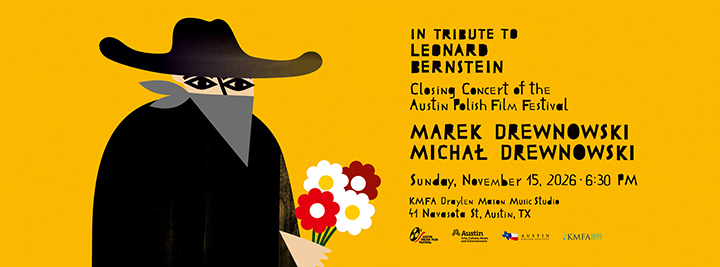
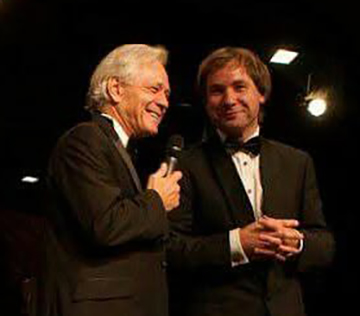
This year’s festival will conclude with In Tribute to Leonard Bernstein. On November 15 at 6:30 p.m., pianists Marek and Michał Drewnowski will perform at KMFA 89.5 Classical’s Draylen Mason Music Studio, 41 Navasota Street. The evening will bring together Polish and American music with Marek Drewnowski’s personal account of his collaboration with the legendary conductor and composer.

In 1985, Marek Drewnowski performed Brahms’s Piano Concerto No. 1 with the Boston Symphony Orchestra under Bernstein’s baton at Tanglewood. During the evening in Austin, his recollections, accompanied by archival photographs, will offer audiences a glimpse behind the scenes of working with one of the twentieth century’s greatest musicians.

The joint appearance of Marek and Michał Drewnowski will also make the concert a dialogue between generations. Father and son will each present their own interpretations before joining one another at the piano for a four-hand finale. The evening will bring the festival’s central theme full circle, recalling how Polish and American paths intersect through art, leaving a lasting impression on musicians and listeners alike.

Design: Patrycja Longawa

From Kościuszko to Wajda, from great literature to contemporary challenges, from a family screening to an evening of music — this year’s festival promises something for audiences with a wide range of interests and sensibilities. There will be time for laughter, emotion, and reflection, and above all for conversations that will continue long after the screenings end.

The festival is organized by the Austin Polish Society. For the full program and ticket information, visit austinpolishfilm.com.


See also: