Nineteenth-Century Łódź as the Promised Land in Władysław Reymont’s Novel
Joanna Sokołowska-Gwizdka
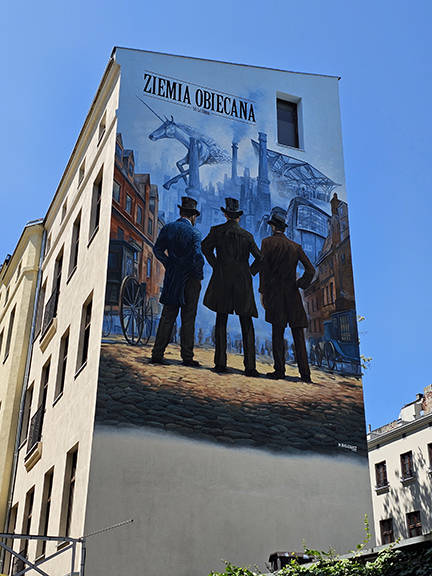
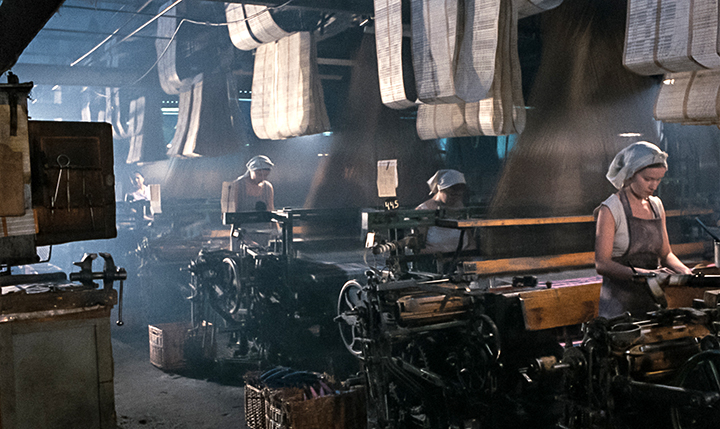
There are cities that take shape slowly, accumulating the memories of generations over centuries. And there are others that spring up almost overnight, born of human enterprise, ambition, and the desire for success. Nineteenth-century Łódź belonged to the latter. Within just a few decades, a small town surrounded by fields and forests was transformed into a mighty industrial center. Where wooden houses had stood not long before, multistory factories, palaces resembling aristocratic residences, and entire neighborhoods of workers’ housing sprang up. Smoke from factory chimneys drifted above the rooftops, and the city lived to the rhythm of machines that never seemed to rest.
People came here from all corners of Europe: Poles, Germans, Jews, and Russians. Some brought capital, others their skills, and still others nothing but the hope that here, at last, their fortunes might change. For many, Łódź was a place where they could begin anew, make a fortune, rise in society, and escape poverty and obscurity.
It was in this city, whose power was built on dreams but also on the ruthless pursuit of wealth, that Władysław Reymont found the inspiration for one of the most important novels in Polish literature — The Promised Land.
*
Reymont and the Epic of Łódź
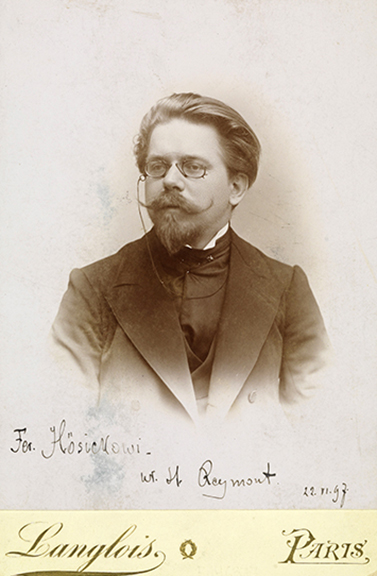
Władysław Stanisław Reymont, born in 1867 in Kobiele Wielkie, was not a writer shaped by academic circles or literary salons. Before gaining literary recognition, he experienced life in all its unpredictability. He trained as a tailor, worked for the railway, and performed with traveling theater companies. He observed people, their weaknesses, hopes, and passions. He was fascinated not only by everyday life but also by the powerful collective forces capable of overwhelming the individual.
In 1896, Reymont traveled to Łódź to see for himself a city growing at a pace unprecedented in the Polish lands. For several months, he observed its daily life, getting to know its people, factories, and the mechanisms behind the creation of vast fortunes. The city’s energy fascinated him, yet it also filled him with unease. In a letter to Jan Lorentowicz dated November 5, 1896, he described the growth of the city, its fortunes, and its business ventures as taking place „with truly American speed.” He saw Łódź as an unstoppable economic force, calling it „a vast stomach devouring people and land.” Yet within this restless, multicultural world, he discovered an extraordinary source of literary inspiration. „Łódź is an epic to me,” he confided to Lorentowicz.
This remarkable vision of the city found expression in his novel. Łódź is far more than the setting for its events. It becomes a character in its own right, an elemental force that imposes its laws upon the people who inhabit it. It draws them into its relentless motion, promises riches, but demands a heavy price in return. From his observations of the industrial metropolis, Reymont created an epic of modern capitalism, in which human dreams, ambitions, and passions intertwine with the ruthless laws of money.
The Promised Land was serialized between 1897 and 1898 and published in book form in 1899. A quarter of a century later, Reymont was awarded the Nobel Prize in Literature for The Peasants, his great epic of Polish rural life. Although these two works explore seemingly opposite worlds, they share an extraordinary ability to portray entire communities, their conflicts, customs, and struggles for survival.
*
Łódź Under Tsarist Rule
The history of industrial Łódź is all the more remarkable because the city flourished at a time when Poland no longer existed on the political map of Europe. The country had been partitioned among neighboring powers, and Łódź lay within the Kingdom of Poland, under Russian rule.
The city’s development was closely tied to the economy of the Russian Empire. Its vast eastern markets offered Łódź’s factory owners opportunities for selling their goods on a scale that proprietors of small weaving workshops could scarcely have imagined. At the same time, industrialists had to contend with the policies of the Russian authorities, their administrative decisions, customs duties, and transportation restrictions.
At the beginning of the nineteenth century, Łódź had only a few hundred inhabitants. By the end of the century, its population had grown to more than three hundred thousand. The transformation unfolded at a pace that inspired both admiration and unease.
The city became home to the vast industrial enterprises of Karol Scheibler, Izrael Poznański, Ludwik Geyer, and other manufacturers. Alongside the factories rose the owners’ grand residences, hospitals, schools, churches, synagogues, and entire neighborhoods of workers’ housing. Wealth existed side by side with poverty, while the city’s rich cultural diversity was accompanied by fierce competition for economic power.
*
Łódź – An Industrial Textile Empire
Reymont’s comparison of Łódź’s development to that of America was no coincidence. The nineteenth century witnessed the emergence of new industrial cities on both sides of the Atlantic, growing at a pace that seemed to defy the established course of history.
In the United States, a similar transformation could be observed in Lowell, Massachusetts, one of the leading centers of the American textile industry. Along the Merrimack River, vast spinning mills and weaving factories sprang up, powered first by water and later by steam. Young women from rural families came to the city seeking employment and financial independence, followed by successive waves of immigrants. Lowell became a symbol of the American Industrial Revolution, embodying both its extraordinary opportunities and its social tensions.
In Pittsburgh, Pennsylvania, fortunes were built on iron and steel. In Chicago, where railroads, the grain trade, and meatpacking fueled economic expansion, the pace of growth evoked the image of a city rising almost overnight. American industrialists such as Andrew Carnegie and John D. Rockefeller became symbols of an era in which capital could transform not only the physical landscape but also the social hierarchy.
Łódź was not an American city. It lacked political freedom and operated under different economic conditions. It remained part of the Russian Empire and developed within a distinct social and political environment. Yet the similarities between these two worlds were striking.
On both sides of the Atlantic, a powerful myth took hold: that through individual initiative, determination, and enterprise, anyone could build a fortune. It was a dream of upward mobility, independence, and seemingly limitless opportunity. In America, it eventually became known as the American Dream. In Łódź, it was the Promised Land.
There was also a less romantic parallel. In both worlds, immense fortunes existed alongside profound social inequalities, harsh working conditions, and conflicts between factory owners and workers.
*
Cotton from America – A Thread Connecting Continents
Yet there was a far more tangible connection between Łódź and America than their shared economic ambitions. That connection was cotton.
The essential raw material of Łódź’s textile industry had to be imported from distant lands. One of its principal sources was the United States, particularly the Southern states, where vast cotton plantations stretched across the landscape.
Texas was among the regions participating in this international trade. Cotton was transported to ports, shipped across the Atlantic, and passed through the hands of European merchants and intermediaries before eventually reaching the continent’s textile mills.
The textile industry of Łódź was therefore dependent on supplies of American cotton. This vulnerability became painfully apparent when the American Civil War broke out in 1861.
The blockade of Confederate ports and the disruption of cotton shipments led to what became known in Europe as the „cotton famine.” The crisis also reached Łódź. In January 1862, Ludwik Geyer’s factories suspended production, partly because of a shortage of raw cotton.
Few examples illustrate nineteenth-century globalization more vividly. From the plantations of the American South to the factories of Łódź stretched an invisible web of economic interdependence, connecting continents, people, and their destinies.
*
The Railway, the Orthodox Cathedral, and the Politics of Wealthy Industrialists
The rapid growth of industry required an efficient transportation system. Yet for many years, Łódź had no direct railway connection. Cotton, coal, and machinery had to be transported by horse-drawn wagons from railway stations outside the city. One such station was Rokiciny, located along the Warsaw–Vienna Railway.
For industrialists, this posed a serious problem. Expanding factories required ever-increasing quantities of raw materials, while finished textiles had to reach distant markets. Łódź’s factory owners therefore lobbied for the construction of a railway line.
It was not until 1865 that Tsar Alexander II authorized the construction of a railway connecting Łódź with Koluszki. Freight services began shortly afterward, followed by passenger services the next year. The opening of the Łódź Factory Railway marked a new chapter in the city’s economic history.
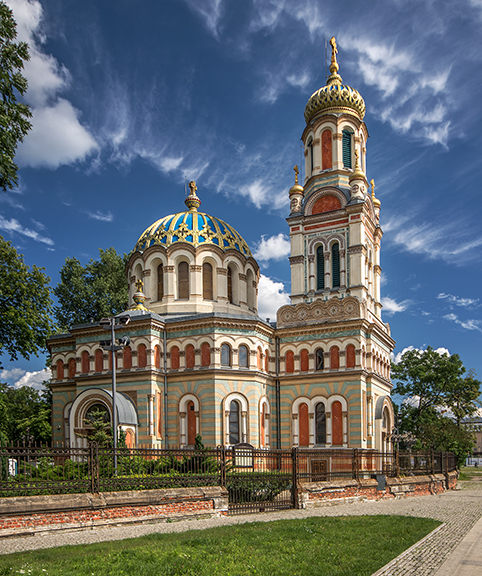
Not far from Łódź Fabryczna Railway Station stands St. Alexander Nevsky Orthodox Cathedral, whose richly ornamented architecture remains a reminder of the era of Russian rule.
The cathedral’s origins were closely tied to the political realities of the time. In 1879, following a failed assassination attempt on Tsar Alexander II, a decision was made to build the church. Among its benefactors were some of Łódź’s wealthiest industrialists, including Karol Scheibler and Izrael Poznański. Designed by Hilary Majewski, the cathedral was completed and consecrated in 1884.
In a city where different nationalities and religions converged, money often proved to be a common language. Economic pragmatism could transcend religious and national boundaries, even as political dependencies and social inequalities remained firmly in place.
*
The Promised Land – Between Biblical Hope and the Illusion of Wealth
The title of Reymont’s novel has its origins in the Bible. The Promised Land, Canaan, was the land toward which Moses led the Israelites — a symbol of hope, freedom, and the fulfillment of God’s promise.
In nineteenth-century Łódź, however, these words took on an ironic meaning.
For thousands of newcomers, the city held the promise of dreams fulfilled. One did not have to inherit a great fortune to imagine becoming a factory owner someday. Courage, ingenuity, perseverance, and a little luck were supposedly all that was needed.
Yet Reymont reveals how easily the promise of happiness can turn into a relentless pursuit of money, and how success can become a force that destroys human relationships.
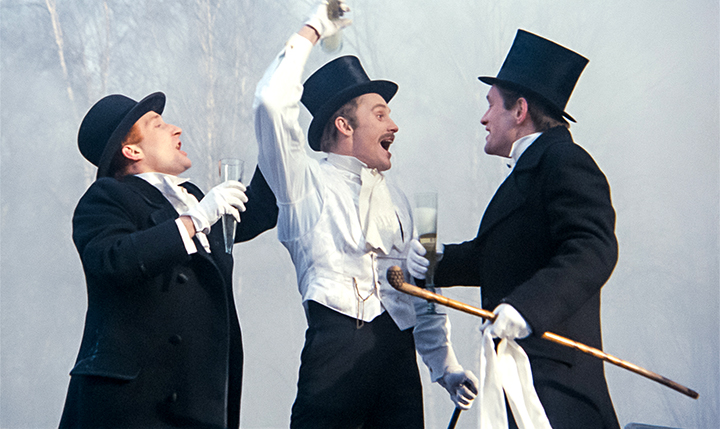
The novel’s three protagonists — Karol Borowiecki, a Pole; Maks Baum, a German; and Moryc Welt, a Jew — come from three different cultural worlds, yet they share a single dream: to establish their own factory and build a fortune.
Their friendship and joint venture become a metaphor for the multinational character of Łódź. At the same time, Reymont portrays a city in which traditional values gradually give way to the logic of profit. Honor, loyalty, love, and even human life can become elements of economic calculation.
Yet the writer does not offer a simple morality tale of wicked rich men and virtuous poor people. His characters are caught in the mechanisms of a world they themselves help create. Money grants them freedom, yet at the same time binds them ever more tightly.
It is precisely this paradox that gives The Promised Land its timeless significance.
*
Andrzej Wajda and His Adaptation of The Promised Land
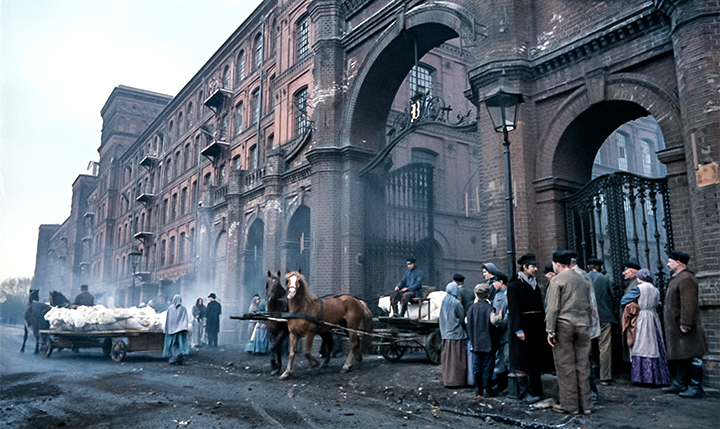
More than seventy years after the publication of Reymont’s novel, Andrzej Wajda returned to the world the writer had created. His monumental film adaptation, produced in 1974 and released in theaters in February 1975, became one of the greatest achievements of Polish cinema. The film received an Academy Award nomination for Best Foreign Language Film.
Daniel Olbrychski as Karol Borowiecki, Wojciech Pszoniak as Moryc Welt, and Andrzej Seweryn as Maks Baum delivered unforgettable performances. The cinematography of Witold Sobociński, Edward Kłosiński, and Wacław Dybowski, together with Wojciech Kilar’s musical score, gave the film extraordinary expressive power. Łódź once again became a character in its own right — a city of movement, noise, fire, opulence, and human suffering.
Wajda did not simply transfer the novel faithfully to the screen. He offered his own interpretation of the story, particularly evident in his portrayal of Karol Borowiecki and in the film’s ending.
In Reymont’s novel, despite his moral compromises and accumulated wealth, the protagonist ultimately comes to a painful realization about his wasted life. He begins to recognize the possibility of finding meaning in serving others. In Wajda’s film, however, Borowiecki is denied this prospect of moral redemption. He remains a man governed by the logic of capital, while the final scene, depicting the brutal suppression of a workers’ protest, gives the story a far sharper social and political dimension.
Wajda also viewed nineteenth-century Łódź through the lens of twentieth-century experience, including the memory of workers’ protests and violence perpetrated by the communist authorities. The result was a film that not only reinterpreted Reymont’s novel but also spoke to the realities of the director’s own time.
*
Artists in Former Industrial Spaces
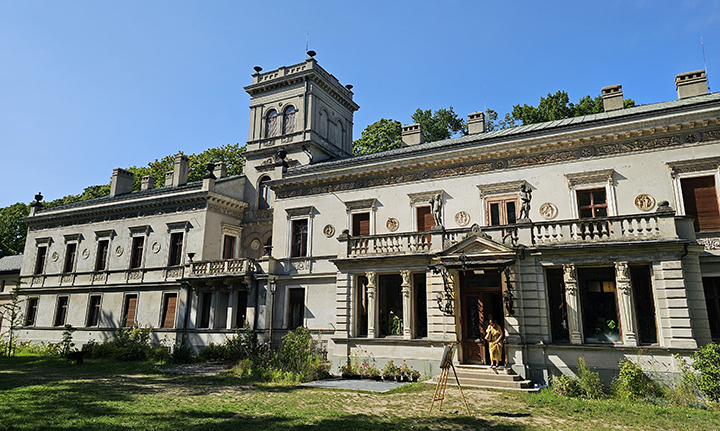
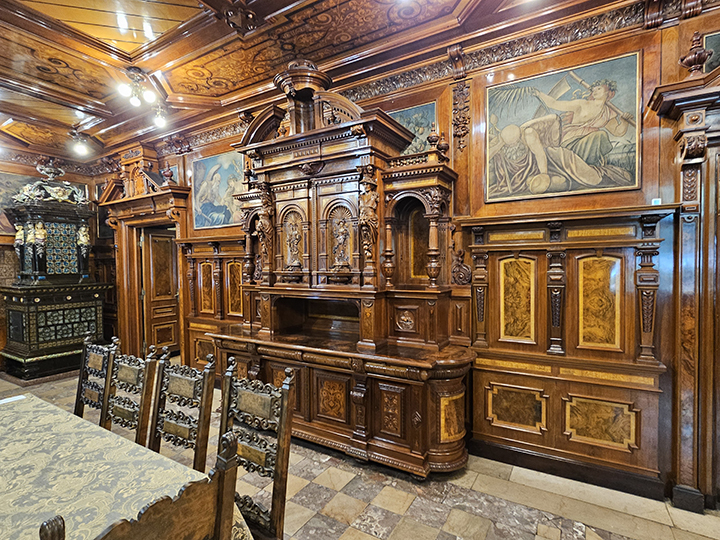
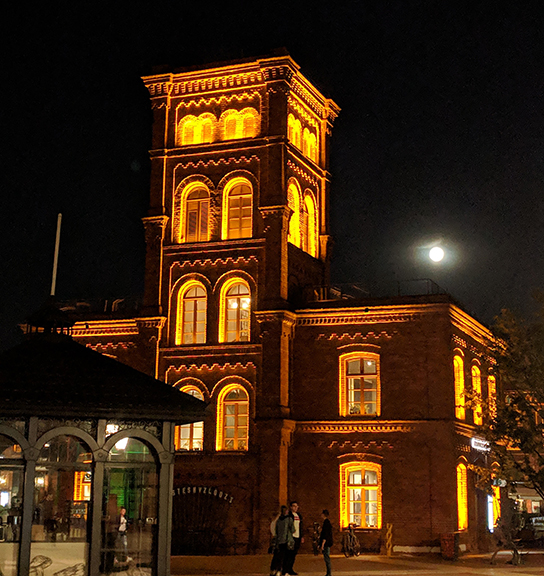
The industrial Łódź of the past has vanished, but its traces remain visible throughout the city. The monumental factories of Scheibler and Poznański, the industrialists’ palaces, the workers’ housing estates of Księży Młyn, churches, Orthodox cathedrals, and former synagogues recall a time when Łódź was one of the most important textile centers in this part of Europe.
Today, these former industrial spaces are being given new life. Within the walls of old factories, museums, galleries, universities, residences, and gathering places are emerging. Łódź, once a city that produced textiles on an enormous scale, is increasingly shaping its identity around culture, art, cinema, and the memory of its own history.
One might say that the city is once again seeking to create its own promised land.
Reymont’s novel raises questions that have lost none of their relevance: Does achieving everything one has dreamed of truly bring happiness? Does wealth mean freedom, or can it become another form of captivity? Must great advances in civilization come at the expense of those who do not share in their rewards?
These dilemmas connected nineteenth-century Łódź with America’s industrial cities. And they continue to resurface wherever people believe that economic success will fulfill their deepest aspirations.
Perhaps this is precisely why The Promised Land remains such a compelling work. It is more than a story about the industrialists of the past, capitalism, and Łódź. It is a story about human nature, the power of dreams, and the price we are willing to pay to make them come true.
This article was prepared with the assistance of ChatGPT (GPT-6, OpenAI) in researching sources and verifying historical information.
*
See also:
Sources:
State Archives in Łódź
Łódź Industrialists (Łódzcy fabrykanci)
Central Museum of Textiles in Łódź
The Myth of Łódź as the Promised Land
Łódź–Poznań Orthodox Diocese
History of the Orthodox Parish in Łódź
Texas State Historical Association
Authors: Karen Gerhardt Britton, Fred C. Elliott, and E. A. Miller.
Cotton Culture – Handbook of Texas
Texas State Historical Association
Authors: Jack Becker and Matthew K. Hamilton.
Wartime Cotton Trade – Handbook of Texas
Texas State Historical Association
Antebellum Texas – Handbook of Texas
National Park Service
Author: Thomas Dublin.
Lowell: The Story of an Industrial City
National Park Service
The Mill Girls of Lowell
Władysław Stanisław Reymont
Ziemia obiecana (The Promised Land), 1899.
Władysław Stanisław Reymont
Korespondencja 1890–1925 (Correspondence, 1890–1925), edited and introduced by Barbara Koc, Ludowa Spółdzielnia Wydawnicza, Warsaw, 2002, pp. 208–209.
Dorota Samborska-Kukuć
“Reymonta osobiste i literackie spotkania z Łodzią” (Reymont’s Personal and Literary Encounters with Łódź), Acta Universitatis Lodziensis. Folia Litteraria Polonica, No. 1 (68), 2024.
National Film Archive – Audiovisual Institute (FINA)
The Promised Land – FINA
Andrzej Wajda – Official Website
The Promised Land – Andrzej Wajda
Polish Film Academy
The Promised Land – Polish Film Academy
Culture.pl
Chronology of Andrzej Wajda’s Life