


How did the extraordinary encounter between Polish pianist Marek Drewnowski and legendary American conductor Leonard Bernstein come about? How does Drewnowski remember working with the maestro and performing Brahms’s Piano Concerto No. 1 under his baton at Tanglewood? Marek Drewnowski shares the story of this remarkable artistic experience, which marked a significant moment in his international career, in an interview with Agata Kwiecińska.
We are publishing this interview on the occasion of the concert “In Tribute to Leonard Bernstein,” which will take place on November 15, 2026, at KMFA’s Draylen Mason Music Studio in Austin, marking the conclusion of the 21st Austin Polish Film Festival.
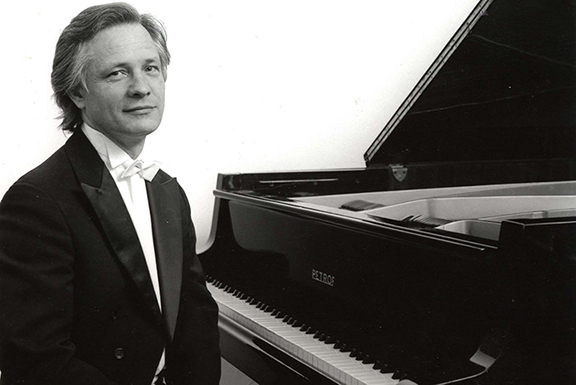
Agata Kwiecińska: The story of your encounter with Leonard Bernstein is almost unbelievable. Bernstein happens to hear your interpretation of Scarlatti’s sonatas on the radio, and…
Marek Drewnowski: It’s a long story. I was in Italy when martial law was declared in Poland. My wife was working with the Orchestra of the Accademia Nazionale di Santa Cecilia in Rome. Five days before martial law was imposed, at practically the last possible moment, we left Poland with our son Michał.
By then, I had already recorded several albums, including a collection of Scarlatti sonatas released by Polskie Nagrania “Muza” in 1974, which Piotr Wierzbicki had encouraged me to record. Despite that, I had to start from scratch in Rome. Our early years in Italy were very difficult, especially because martial law made communication with Poland impossible.
I had no contacts, no connections, and, of course, no work. It was only after a few years that I began performing in public. I made some Italian friends, the family of Fernando Martinelli, who helped me enormously. They found me a few students and later organized masterclasses as well. At the time, I was playing Brahms, less Chopin (as he was less popular in the land of opera back then), and, of course, Scarlatti.
I gradually developed my musical career in Italy, and little by little, the country became my second homeland. We had neither the courage nor any reason to return to Poland.
Several years passed. Our daughter Marta was born in Rome, I was giving more concerts, and we moved apartments several times. Eventually, Father Boniecki helped us find an apartment in the city center, in the San Giovanni in Laterano neighborhood. Rome is a wonderful city, but also a difficult and dynamic one, with traffico—heavy traffic—and a great deal of noise. Our new apartment was pleasant, centrally located, and close enough to the Colosseum to walk there.
One day, the postman handed me a telegram. Astonished, uncertain, and curious, I opened it and found a message from PAGART that read: Please contact us, as Leonard Bernstein would like to get in touch with you.
My head was spinning with disbelief, joy, and doubt. I thought it was a joke. I wondered who could possibly be playing such a trick on me. Once I had calmed down, I began investigating, calling friends and acquaintances, trying to find the culprit. But nobody admitted to anything. Finally, I contacted PAGART, and it turned out to be true.
What did you know about Bernstein at the time?
I knew he was one of the greatest conductors in the world. I had attended his concerts in Italy. I particularly remember a concert at the Vatican with the Orchestra of Santa Cecilia.
What did you learn from PAGART?
They gave me the phone number of Bernstein’s secretary, Harry Kraut. I called and introduced myself. Kraut was clearly delighted and told me that Leonard Bernstein was determined to meet me. We arranged a date. He said Bernstein would soon be in Milan and that I should come to La Scala. I was so overwhelmed that I couldn’t sleep for several nights.
How did all this come about? How had Bernstein discovered you?
At that point, I still knew nothing. I simply bought a ticket to Milan. La Scala was presenting Bernstein’s short opera Trouble in Tahiti. He wasn’t even conducting; he had just come to attend the performance.
I had arranged to meet Harry Kraut outside La Scala. I was carrying a small suitcase and wearing a short-sleeved shirt because it was very warm. I stood outside for quite a while, but nobody came to meet me. Eventually, I approached a man standing in front of the theater and asked where the artists’ entrance was.
It turned out to be Harry Kraut himself, who had been waiting for me. When he saw me, he exclaimed in astonishment, “But you were supposed to be a professor with a gray beard!”
He was genuinely amazed. Once he had recovered from his surprise, he took me inside the theater. Bernstein was standing near the entrance to the stage. A rehearsal of his opera was about to begin, but he called for a break. He, too, was surprised and immediately began telling everyone about my Scarlatti recordings. There was quite a commotion.
Then Bernstein took me by the arm and ushered me into a camerino, a dressing room, where there was a piano. He immediately told me to play.
I turned around and was terrified. A crowd of curious people had gathered behind me. I played several Scarlatti sonatas, ending with a virtuosic one in G major. I must have made an impression on that unexpected audience because they burst into applause and cries of admiration.
But Bernstein himself left me speechless when he took my hand and kissed it. I thought I was going to faint from the excitement.
Later, I remember it perfectly, I was performing Mussorgsky’s Pictures at an Exhibition, accompanied by Kandinsky’s paintings, in Berlin. It was winter, probably around Christmas. There was snow on the streets.
That was where I received a phone call from Kraut telling me that the maestro wanted to perform one of Brahms’s piano concertos with me, whichever I preferred. With the Boston Symphony Orchestra, conducted by Bernstein himself!
I suggested Piano Concerto No. 1 in D minor, but then realized I couldn’t even remember how it began.
When Harry Kraut asked whether I had ever performed the concerto before, I said yes. In a way, I was lying, because I had only played it with a student orchestra.
You had about six months, which is quite a lot of time, even to learn a completely unfamiliar piece.
I returned to Rome and immediately went to a music store to buy the score, feeling extremely stressed. It was quite a funny situation. And before I left for Boston, the director of La Scala invited me to give a recital.
So that informal audition with Bernstein produced some tangible results.
Yes, and in other ways, too. Taking advantage of my acquaintance with the director, I asked him to invite me to a Horowitz recital. And I got to hear him perform.
I also wanted to get an autograph for my friend, the journalist Jan Weber. In the same camerino where I had met Bernstein, I found some large photographs of Horowitz. I asked for an autograph, but I wasn’t allowed to approach him.
His secretary took the photograph and arranged to meet me another day at the Hotel Principe di Savoia. But Horowitz refused to sign it, saying that he wasn’t abbastanza bello (handsome enough) in the photographs.
Did you manage to perform Brahms’s Piano Concerto No. 1 before leaving for the United States?
No, not at all. I had no opportunity to do so. In Italy, I was still considered a newcomer to the concert scene.
What was your journey to Tanglewood like?
It was quite an adventure! I didn’t speak the language, had never been there before, and had no idea how to organize the trip.
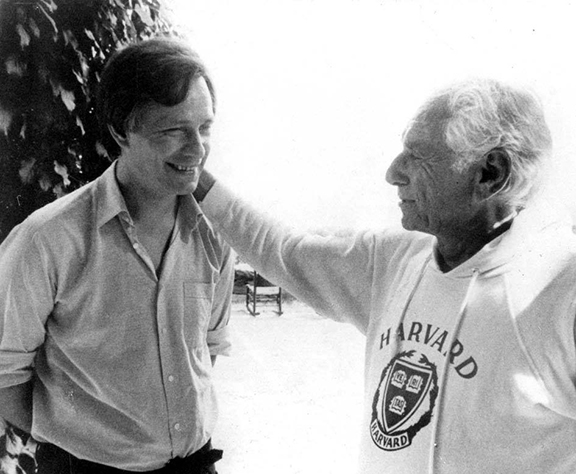
Marek Drewnowski and Leonard Bernstein. Photo from Marek Drewnowski’s private archive.
And what language did you speak with Bernstein, since you didn’t speak English?
Italian. But returning to my trip, through various connections, I managed to arrange a place to stay for a few days with a theater director in New York. Before that, I had flown with several connections, including one through Belgrade. Eventually, I took a bus from New York to Tanglewood. When I got off the bus, there were no taxis or any other means of transportation. In the end, some… cowboy gave me a ride for five dollars.
Once I arrived, I was accommodated in a hotel, but I still couldn’t sleep. Kraut found me and told me when the rehearsal would take place. He also assigned me an assistant who spoke Italian.
I went to the rehearsal with a lump in my throat. I was supposed to play the Brahms concerto with a second piano standing in for the orchestra. A select audience began gathering in the rehearsal room: a few curious orchestral musicians, then a woman who entered with an extremely serious expression, followed by an assistant carrying a small towel, and finally Kraut with the baton. It was quite a ritual!
At last, Bernstein himself appeared, and we began to play. My anxiety disappeared. The rehearsal was very enjoyable because the maestro offered some interesting advice.
What kind of advice did he give you?
It was about emotions.
How many rehearsals did you have?
One with the piano and another with the orchestra. That was all.
I remember being driven to the concert. The concert hall at Tanglewood is enormous. I can still recall the feeling as we approached the venue and suddenly I heard a roar, as if we were approaching a stadium. There were 12,000 people in the audience, and the concert was being broadcast live.
How did you feel about your performance? Do you remember much of the concert itself?
At first, I was still warming up, and I played a few wrong notes. But as the concert progressed, things got better, and the finale was definitely the best part. I must admit that I remember absolutely nothing of what happened after the concert. I was completely exhausted. But Bernstein was pleased. He said it had gone well.
Later, listening to the recording, and now looking back after all these years, I can hear a certain generational difference in our performance. I was bursting with youthful energy, while he was trying to restrain it, to hold me back. My tempos were completely different, but I was the one who had to adapt. There was a certain tension between us musically, which I only came to understand many years later, when I began conducting myself.
Did you ever perform at Tanglewood again?
No, but Bernstein invited me to perform at a concert commemorating the anniversary of the outbreak of World War II, held at the Grand Theatre in Warsaw in 1989. I played Chopin’s Polonaise in A-flat major.
I regret that Bernstein died so soon after that meeting. I lost my mentor. He taught me more than anyone else, even though he never gave me formal lessons.
What did he teach you? After all, you didn’t meet that many times.
He invited me to his concerts in Europe, so we saw each other from time to time. There were always social gatherings afterward, with Bernstein at the center of everyone’s attention.
I learned from him how to work with an orchestra and how to build the structure of a musical work. During the rehearsal at Tanglewood, he also conducted Brahms’s Symphony No. 1. The orchestra seemed literally to soar. There was an extraordinary combination of emotion and intellect.
Meeting him was also a lesson in psychology for me: how to withstand pressure and how to defend my own artistic vision.
How did Bernstein discover you in the first place?
One morning, Bernstein woke up, turned on the radio, and heard Scarlatti’s sonatas. They were my recordings from a vinyl LP released by Polskie Nagrania. He was intrigued by the performance, and his curiosity grew when the radio station failed to announce the pianist’s name.
He called the station, but the staff told him they hadn’t broadcast any Scarlatti sonatas; they weren’t on the program. Bernstein became irritated because he knew perfectly well what he had heard. He insisted on finding out who the performer was.
After several days, the New York radio station finally found the answer. It turned out that there had been a gap in the schedule after a broadcast, so someone had reached for my record to fill it. Perhaps it had simply been lying on top of a pile.
But how did your record end up at a radio station in New York?
I have no idea. We never managed to find out. It was an unbelievable twist of fate. Nobody could pronounce my name; nobody had ever heard of Drewnowski. Bernstein instructed his assistant to track down the musician whose interpretation of Scarlatti had intrigued him so much.
It shows just how much music meant to him, and how attentively he listened. He could have performed with the world’s greatest soloists, yet he decided to seek out someone whose interpretation had captivated him. Remarkable.
He was an extraordinary man, especially during rehearsals. Sometimes he would say to the orchestra, „I love you all.”
I once saw someone bring a small child to a rehearsal. Bernstein picked the child up, hugged him, made him laugh, and then lay down with him on the floor, right in the middle of the stage.
He did an incredible amount for young musicians and helped launch the careers of many outstanding artists.
He was a man who truly lived for music, who craved it. The fact that he was listening so attentively to the radio at ten in the morning shows that he needed music every moment of his life. Like an addict.
He was a man who loved. He loved the world, music, and people. He loved unconditionally.
I miss him…
*
Agata Kwiecińska’s interview, titled “The American Dream,” was originally published in Ruch Muzyczny, issue 11/2018.
Reprinted with permission from the editorial team and the author.


