Joanna Sokołowska-Gwizdka
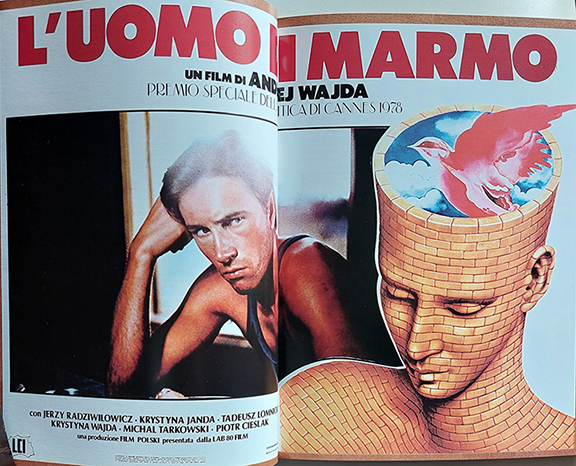
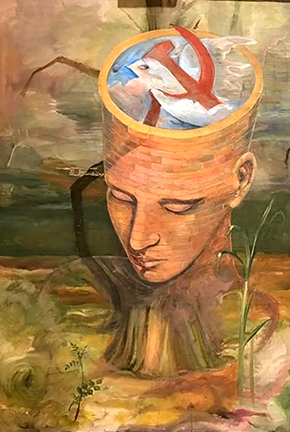
One of the Italian posters for Andrzej Wajda’s Man of Marble conceals a story far larger than the history of the film itself. It begins with a painting by Franco Scepi depicting a man whose head is built like a brick wall, from which a dove emerges together with the hammer and sickle. Then the symbols of communism disappear. Nearly twenty years later, in a handwritten letter to the artist, Andrzej Wajda would write: “I persuaded you at the time to change the concept and censored the work.” And the image, born in the 1970s, would begin an entirely new life as Man of Peace — a symbol associated with Mikhail Gorbachev and Nobel Peace Prize laureates.
When I approached the Italian artist Franco Scepi to ask permission to display his poster for Man of Marble in an exhibition being prepared for the Austin Polish Film Festival, I expected a brief answer: yes or no.
Permission came. But with it, I received something I had not expected at all.
Franco Scepi sent photographs, documentation tracing the successive incarnations of his work, and a copy of a handwritten letter from Andrzej Wajda. He wrote that he wanted to share a story he considered very important and one that, in his view, is not widely known in Poland. He had created the poster at Andrzej Wajda’s request in 1978.
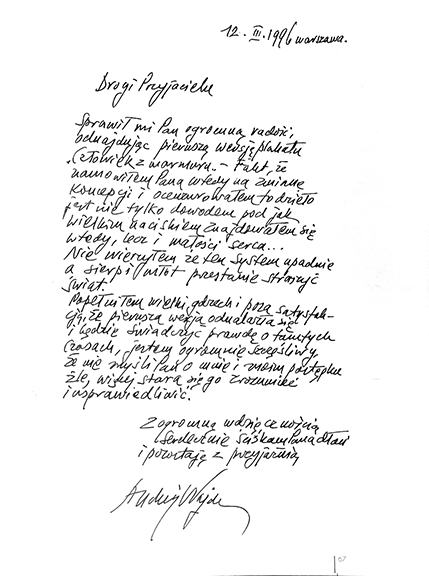
The most remarkable item, however, was a one-page letter dated March 12, 1996, handwritten by Andrzej Wajda to Franco Scepi. It begins with the words: “Dear Friend.”
Andrzej Wajda writes that he was immensely pleased that the first version of the poster for Man of Marble had been rediscovered. Then comes a sentence one would hardly expect: “At the time, I persuaded you to change the concept and censored the work.”
The director does not shift responsibility onto some anonymous “censorship.” He writes in the first person. He adds that his decision was evidence not only of the pressure he was under at the time, but also — as he himself puts it — of his “smallness of heart.” He admits that he did not believe the communist system would ever collapse or that the hammer and sickle would cease to “haunt the world.”
It is an extraordinary testimony. Not because it reveals the existence of censorship in communist Poland — we know that all too well. What is extraordinary is that, nearly twenty years later, one of Poland’s most distinguished film directors returned to a single decision concerning a poster and described his own conduct without constructing an exculpatory narrative around it.
There is something profoundly human in this letter: the memory of fear, an awareness of compromise, and relief that the original version of the work survived.
A Head Made of Brick
Franco Scepi’s first painting is unsettling. A human head rises from the ground, built like a wall of bricks. The skull is open. Inside it, against a background of sky, are the hammer and sickle, intertwined with the movement of a white bird.
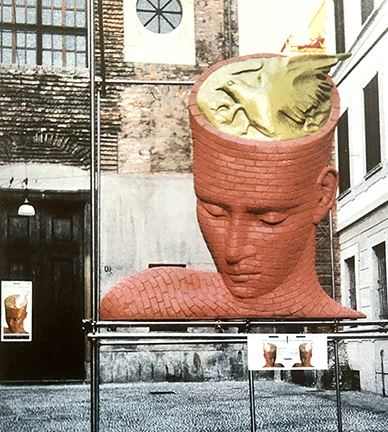
Franco Scepi recalls that the painting was created in 1977 and that its inspiration was connected with Kraków and the then Archbishop of Kraków, Karol Wojtyła. Today, a monumental version of the work is housed at Museo MAGI ’900.
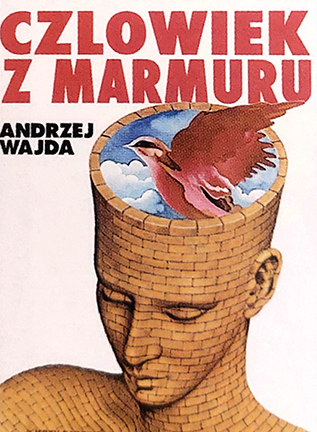
In 1978, the artist created a design based on the same motif. A year later, he returned to it when preparing the Italian poster for Andrzej Wajda’s Man of Marble. But something had changed. The hammer and sickle had disappeared.
On the L’uomo di marmo poster, the man built of bricks remains. His head is still open to the sky, but now only the bird emerges from within. The hammer and sickle are gone.
If we had only the two images, one might wonder whether this was an aesthetic decision, a change in composition, or an intervention by the Italian distributor. The 1996 letter removes that uncertainty. It was Andrzej Wajda who asked Franco Scepi to change the concept. And years later, Wajda himself described that intervention as censorship.
There is an extraordinary paradox in this story, because Man of Marble is itself one of the most important Polish films about the manipulation of truth by the communist system.
Aleksander Ścibor-Rylski’s screenplay had been written many years earlier, but for a long time it could not be produced because of censorship. The film follows Agnieszka, a young film-school student who tries to reconstruct the fate of Mateusz Birkut — a model worker created by Stalinist propaganda and later erased from official memory.
A film about uncovering the truth beneath a propagandistic image therefore received a poster from which the director himself — under pressure from the political system — persuaded the artist to remove the system’s most direct symbol.
It would be hard to imagine a more ironic commentary on the realities of communist Poland.
Birkut Built of Bricks
Franco Scepi’s poster is also an exceptionally apt interpretation of the film. Mateusz Birkut is a bricklayer. Propaganda constructs him almost literally out of bricks: production records, newsreels, speeches, and a carefully staged image of the “new man.” In Franco Scepi’s work, the man himself becomes a wall.
There is no conventional portrait of the actor. The face no longer belongs only to Birkut. It is more universal, almost anonymous. The wall encloses the man, yet it is precisely in his head that a space opens through which one can escape. The dove flying upward can be read as freedom, thought, truth — something that cannot be completely walled in.
The first version, however, was more overtly political. The bird was not merely escaping confinement: it was carrying the hammer and sickle away with it.
In 1978, Man of Marble was shown at the Cannes Film Festival and received the FIPRESCI Prize, awarded unanimously by the International Federation of Film Critics. Franco Scepi’s Italian poster belongs to this period.
The film began its international life. As it would turn out, Franco Scepi’s image did as well.
The First Version Returns
In 1996, the first, unused version of the work was rediscovered. For Andrzej Wajda, it must have been an encounter with his own past. In his letter to Franco Scepi, he writes that he is pleased not only that the painting has been found, but also that it will be able to “bear witness to the truth about those times.”
The words that follow are even more moving. Andrzej Wajda thanks the artist for not judging his conduct at the time solely as an act of cowardice, but for trying to understand it. The letter ends warmly — with gratitude, a handshake, and an assurance of friendship.
At this point, the history of the poster ceases to be a simple story of “artist versus censor.” Andrzej Wajda himself was operating within the system: negotiating, yielding, and trying to get his films made. Man of Marble, after all, was a film he had waited many years to bring to the screen.
His letter reveals a mechanism far subtler than an official’s red stamp: self-censorship born of an awareness of the boundaries whose violation could have jeopardized the entire undertaking. It also reveals the psychological cost of such decisions, still remembered twenty years later.
From Man of Marble to Man of Peace
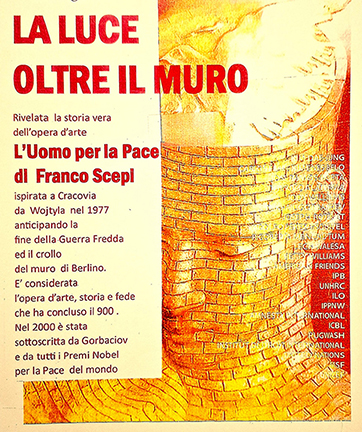
The story could have ended there, but it did not. The motif of the man with a wall-like head reappeared in Franco Scepi’s work under the name L’Uomo della Pace – Man of Peace.
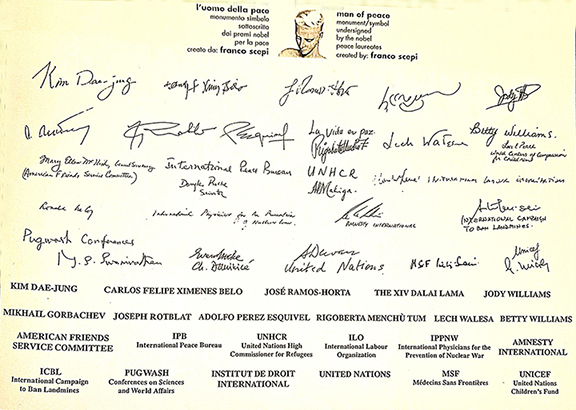
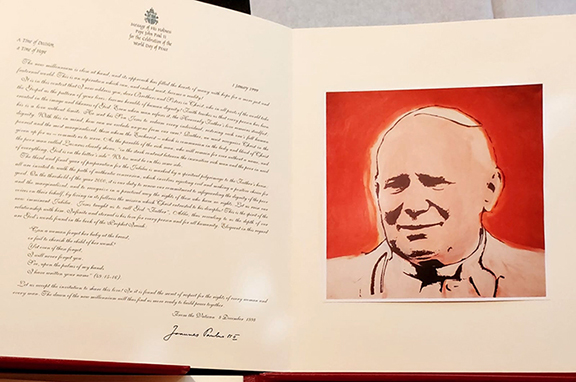
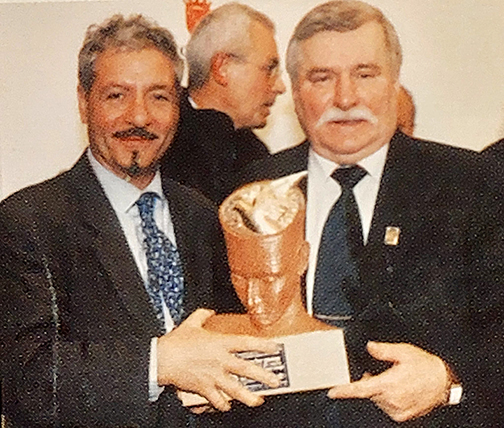
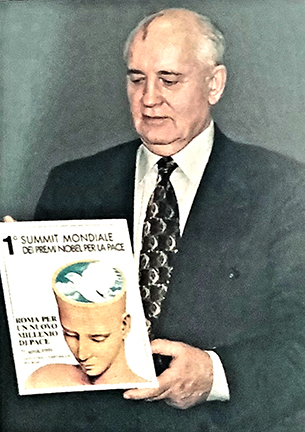
In the 1990s, the work became associated with initiatives led by Mikhail Gorbachev and the World Summit of Nobel Peace Laureates. In 1999, the image was signed in Rome by Nobel Peace Prize laureates, including Mikhail Gorbachev, Lech Wałęsa, the 14th Dalai Lama, Rigoberta Menchú, José Ramos-Horta, Jody Williams, Adolfo Pérez Esquivel, and Betty Williams, as well as representatives of organizations that had received the Nobel Peace Prize.
The signatures of these laureates appear beneath the work. Representatives of organizations awarded the Nobel Peace Prize also signed it, including the United Nations, Amnesty International, UNHCR, UNICEF, the International Labour Organization, and Médecins Sans Frontières.
The symbol whose communist meaning had been softened on the film poster in the 1970s thus returned, after the collapse of that system, in an entirely new context.
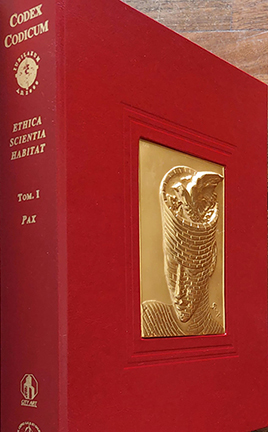
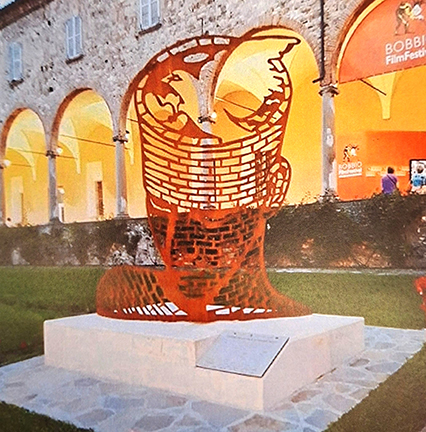
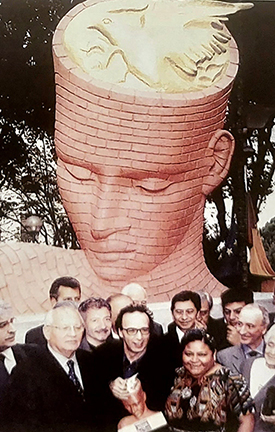
Monumental versions of Man of Peace were created. One of them is housed at Museo MAGI ’900 in Pieve di Cento, where a separate section of the collection is devoted to the work. Its history leads from the 1977 painting, through the poster for Andrzej Wajda’s film, to a symbol of peace associated with Mikhail Gorbachev.
According to Franco Scepi, this transformation is precisely what gives the work its particular significance: an image inspired by the experience of communism and by the dream of transcending political walls came, many years later, to function among people who had taken part in the peaceful ending of the Cold War.
*
Monumental version of Franco Scepi’s L’Uomo della Pace (Man of Peace) during an event associated with the World Summit of Nobel Peace Laureates, Rome, 2002. Photo courtesy of Franco Scepi.
Mikhail Gorbachev with material devoted to the World Summit of Nobel Peace Laureates, featuring the motif of Franco Scepi’s L’Uomo della Pace (Man of Peace), 2004. Photo courtesy of Franco Scepi.
The Letter Matters Most
One can admire the later monuments. One can trace the signatures of Nobel laureates. One can tell the story of Gorbachev, Wojtyła, Andrzej Wajda, and the extraordinary journey of a single image through the final decades of the twentieth century. For me, however, the most valuable document remains a single sheet of paper: Andrzej Wajda’s letter. It contains something far rarer than political declarations: an artist’s acknowledgment of his own compromise.
Andrzej Wajda does not write from the perspective of someone who knew from the beginning that communism was bound to collapse. On the contrary. He admits that at the time he did not believe it would. That sentence changes the perspective.
It is easy to look back at the past knowing how it ended. It is far more difficult to remember what the future looked like to someone living within a system that seemed permanent.
In 1978, the hammer and sickle disappear from the poster.
In 1989, the Berlin Wall falls.
In 1996, Andrzej Wajda looks at the rediscovered original image and writes to Franco Scepi that he had never imagined the system would truly pass away. And the image of the man built of bricks lives on.
That is perhaps the most beautiful paradox of this story: the version that once could not be shown ultimately survived as a witness to its time. Exactly as Andrzej Wajda had hoped.
*