

Maria Duszka
It was the late 1960s. The book On the Border Between Life and Death: Letters and Secret Prison Notes of Krystyna Wituska was passed from house to house, from hand to hand. It was probably read, one after another, by nearly everyone in Małyń and Jeżew, villages in the Zadzim municipality of Poddębice County. I was no more than ten years old at the time, and although it was certainly not a book intended for children, I read it too. What I remember finding most puzzling was that this young woman, held in a German prison and sentenced to death, asked her parents to send her stockings and a silk dress. I imagined that in such circumstances one would not think about such small things.
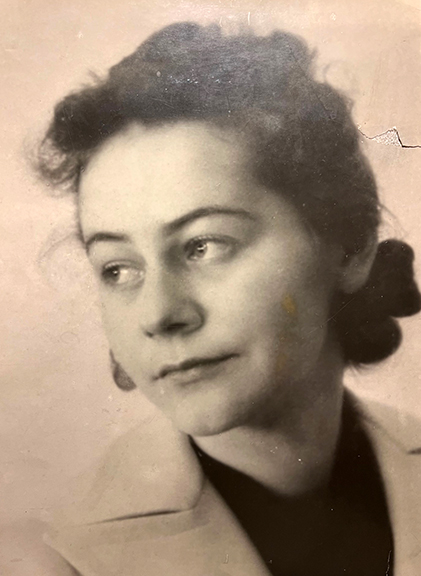
Krystyna Wituska was born on May 12, 1920, in Jeżew, a village that at the time belonged to the Krokocice municipality in Sieradz County. Her parents, Maria and Feliks Wituski, owned the estates of Jeżew and Kłoniszew. When she was ten years old, she and her older sister were sent to a school run by the Ursuline Sisters in Poznań. She completed the lower-secondary school leaving examination at Queen Jadwiga Gymnasium in Warsaw. When she began suffering from tuberculosis, her parents sent her first to Zakopane and later to Switzerland. She returned to Poland shortly before the outbreak of the war.
In 1940, her family was expelled from Jeżew. Feliks Wituski became the administrator of an estate in Kałęczew near Głowno, and later in Brwinów. Krystyna settled in Warsaw. Probably in 1941, she became involved with the Union of Armed Struggle, an underground organization later transformed into the Home Army. Her work involved establishing contacts with German soldiers and obtaining information from them about the weapons and strength of their units.
She was arrested in October 1942. The Germans found on her the addresses of two young women who worked with her, Maria Kacprzykówna and Wanda Kamińska. All three were imprisoned in Pawiak Prison and, after several days, transferred to Berlin. At first they were held in the prison on Alexanderplatz; later they were moved to Alt-Moabit.
*
CHAMOMILE FLOWERS IN A GLASS
A total of 76 letters and secret prison notes written by Krystyna have survived. She wrote them to her parents, her sister, and her friends. She tried not to show discouragement; instead, she did everything she could to keep up the spirits of those closest to her. She was extraordinarily brave and composed. Her candor and emotional maturity are striking. Until the very end, she remained sensitive to fragments of beauty and to small acts of kindness and goodwill.
The women sharing her cell changed frequently. Close friendships formed quickly, including among women of different nationalities. And sometimes they ended just as quickly. None of the imprisoned women was released—some were sentenced to death, others were sent to concentration camps. For Krystyna, being separated from them became an additional source of suffering.
On February 14, 1943, she wrote from Alt-Moabit:
“Two trees grow outside my window, and I can also see a small patch of sky. A tiny spider lives in the corner of my cell—he is my only companion. Dear Mother, this letter would be infinitely long if I tried to describe all the thoughts that run through my mind during the day. Soon I will become a philosopher in this solitude.”
Two weeks later, she wrote:
“Walking around the courtyard during our free hour, I look up at the sky, watch the clouds drifting above the high prison walls, and somehow I smile with joy. I feel sorry for people who see far more beautiful views every day but do not know how to take joy in them because their hearts are too narrow or too cold.”
In another letter she wrote:
“It would be comforting to believe that on the other side one will find again all those one has loved, because can such a powerful feeling as love simply disappear?” (…) “Death is a deliverance for all people.”
And yet she was still able to take pleasure in small things:
“Thank you very much for the dress and the other things. Today I dressed up in it for chapel and looked very elegant.”
And on another occasion:
“We have four chamomile flowers in a glass in our cell. They are the first flowers we have had in prison, and it seems to us that we have never seen anything more beautiful.”
Despite the nightmare in which she lived for nearly two years, toward the end of her life she wrote:
“Do not think, however, that these tragic experiences have made me melancholy. On the contrary, I have learned to take joy in life and to regard every beautiful hour as a gift from heaven.”
On April 19, 1943, the Military Court of the Third Reich sentenced her to death by guillotine “for espionage and complicity in the crime of high treason.” In the same trial, Maria Kacprzyk was sentenced to eight years and Wanda Kamińska to three years in a penal camp. Both women survived the war.
Krystyna tried to come to terms with her situation and to distance herself from it as much as possible. Even after receiving her sentence, she sought to comfort those closest to her:
“People on the outside imagine that someone sentenced to death loses their mind with fear and despair. In reality, however, it is quite different. Perhaps because it seems impossible to comprehend. (…) Just be brave, my dearest Mother, always hold your head high, and forgive me for having done something like this to you. (…) Mother, send me my navy-blue silk dress and some hair-washing powder again. I shall remain vain forever, and even on my last day I will curl my hair.”
In a letter to the mother of her fiancé, Zbigniew Walc, she wrote:
“I do not feel unhappy knowing that I must die; after all, all people live with that knowledge, the only difference being that they do not know the hour. (…) The most important thing is to maintain one’s composure to the very end, not to allow some animal instinct for survival to take over at the last moment, not to be afraid of that single second of physical pain.”
Yet in one of her letters to a German friend, she confessed:
“I want to get out of these four walls that I keep circling slowly, over and over again—to go out and meet life! From time to time, when I think that everything inside me has already died, that wild longing comes over me again.”
In December 1943, Krystyna was transferred to the prison in Halle/Saale. Her spirits deteriorated considerably at that time. Probably in order to occupy her mind and keep herself from sinking into despair, during this final period of her life she devoted herself intensively to learning Italian and shorthand.
In her farewell letter to her parents, she wrote:
“I am completely calm. Believe me, I will remain calm until the very last moment. My final duty toward Poland and toward you is to die bravely!”
On June 26, 1944, she was executed by guillotine. She was 24 years old. Her body was buried in a mass grave at the Gertraudenfriedhof Cemetery in Halle/Saale.
One of the guards at Alt-Moabit Prison was Hedwig Grimpe. She had been assigned there under compulsory labor regulations. She opposed fascist ideology, sympathized with the prisoners, and, as far as she was able, treated them with kindness. She brought them food, medicine, and cigarettes. She became friends with Krystyna. After Krystyna’s death, Helga, Hedwig’s daughter, wrote a moving letter to Maria Wituska on her mother’s behalf.
And what happened to Zbigniew Walc? He was sent to the Mittelbau-Dora concentration camp. In early April 1945, as American troops approached, the prisoners were evacuated by train. Because the railway tracks had been destroyed, the transport stopped at Gardelegen near Magdeburg. There, the Germans locked approximately one thousand prisoners inside a brick barn and set it on fire. Zbigniew Walc was among them.
*
THE POLITYKA AWARD AND A TELEVISION THEATRE PRODUCTION
In 1968, the State Publishing Institute published the book I mentioned earlier, On the Border Between Life and Death: Letters and Secret Prison Notes of Krystyna Wituska, edited by Wanda Kiedrzyńska, a historian and former prisoner of the Ravensbrück concentration camp. That same year, Krystyna was posthumously awarded first prize by the weekly magazine Polityka in the category “Diaries, Accounts, Memoirs.” Two years later, a second, expanded and revised edition was published.
In 1978, My Beautiful Birthday, a Television Theatre production based on the book, premiered. Krystyna was played by Jadwiga Jankowska-Cieślak, while her parents were portrayed by Ryszarda Hanin and Piotr Pawłowski. Unfortunately, the production is not available online, so we can only hope that it will one day be rebroadcast on television.
On March 26, 2010, President Lech Kaczyński posthumously awarded Krystyna Wituska the Commander’s Cross of the Order of Polonia Restituta for her outstanding contribution to the independence of the Republic of Poland. The decoration was presented by Maria Kaczyńska to Krystyna’s nephew, Mikołaj Tomasz Steppa.
In April 2025, the exhibition The Reich Court-Martial 1936–1945: National Socialist Military Justice and the Suppression of Resistance in Europe opened at the Museum of Cursed Soldiers and Political Prisoners of the Polish People’s Republic in Warsaw. Krystyna Wituska was one of the figures featured prominently in the exhibition.
Krystyna Wituska’s story has also attracted considerable interest in Germany. In 2014, on the 70th anniversary of her death, an obelisk was erected in Halle. It bears a relief depicting her face. The anniversary of her death—June 26—is commemorated there every year as a day of remembrance for all victims of Nazism who were executed in the city.
In 2019, the writer Simone Trieder published a book in Germany about Krystyna and her fiancé, Nik und Tina: Gefährliche Briefe 1938–1944 (Nik and Tina: Dangerous Letters 1938–1944). It is a nonfiction account of letters discovered in the 1960s during renovation work at the manor house in Jeżew and of the story of Krystyna and Zbigniew’s engagement.
*
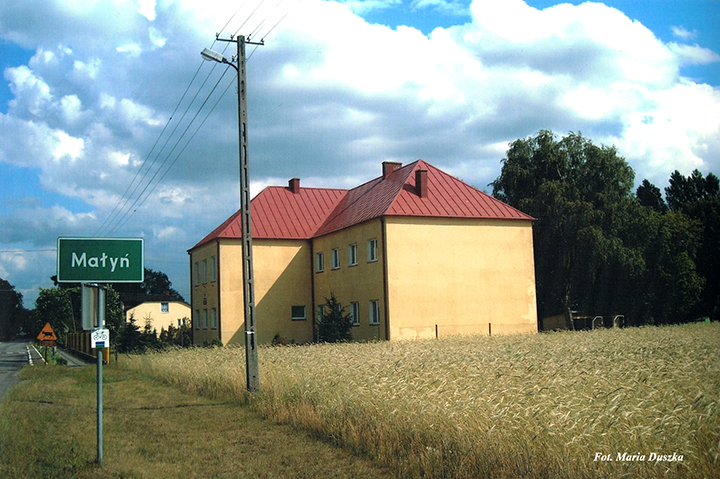
IN HER HOME REGION
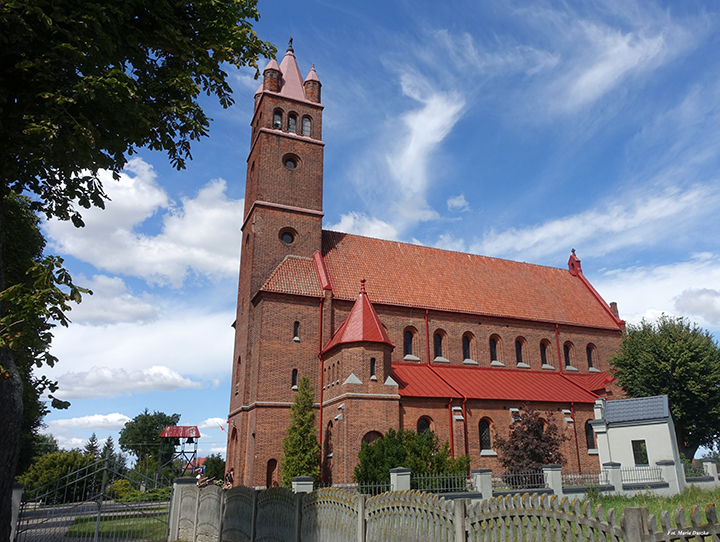
In 1938, a school—then commonly referred to as an elementary school—opened in Małyń. The initiative to build it came from Feliks Wituski. In 1984, the Primary School was named after Krystyna Wituska. Unfortunately, 25 years later, it was closed.
On February 27 of this year, a commemorative plaque dedicated to Krystyna Wituska was unveiled at the Primary School in Zygry, which is now also attended by children from Małyń. The plaque was funded by the Łódź Branch of the Institute of National Remembrance. Mikołaj Tomasz Steppa was also invited to attend the ceremony. It was about him that Krystyna once wrote in a letter to her sister: “Little sister, raise your son in the spirit of peace; may he never become a soldier. War is cruel and terrible.”
One of Krystyna’s school friends once described her in her diary with the words: “Soft as wax, hard as steel.” Time proved this to be an exceptionally accurate characterization.
In one of her letters to her family, Krystyna wrote: “If I had literary talent, I would immediately start writing a novel. It would certainly be tremendously interesting, sometimes tragic, but not without the sense of humor that never leaves us.” Well, she never wrote a novel, but she probably never imagined that her letters would one day be published. Nor that everyone who read them would be deeply moved by her tragic fate and extraordinary personality.
The article was originally published in the Łódź cultural magazine Kalejdoskop, No. 6/2026.
*