


Wilhelm Sasnal’s Paintings in The Assistant
*
Joanna Sokołowska-Gwizdka
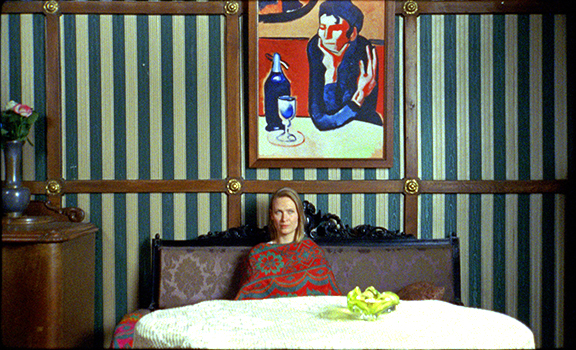
The paintings were created for a film. They were meant to hang on the walls of an elegant villa, accompany the characters, and help shape the atmosphere of the story. Yet before Anka and Wilhelm Sasnal’s film The Assistant reached cinemas, the canvases painted by Wilhelm had already found their way into the Stedelijk Museum in Amsterdam. What was intended as part of a film set became the subject of an artistic story of its own.
These paintings echo the work of the great masters of the European avant-garde — Henri Matisse, Pablo Picasso, and Georges Braque. Sasnal, however, does not simply copy their works. Instead, he enters into a dialogue with them, drawing on recognizable motifs and giving them new meanings.
Masters of the Avant-Garde in the Toblers’ Villa
The Assistant, inspired by Robert Walser’s 1908 novel, takes us, among other places, into the elegant villa of the inventor Carl Tobler. Inside, among the furniture and everyday objects, hang paintings that are sure to catch the eye of anyone familiar with the history of modern art.
Familiar shapes, colors, and compositions emerge, as though Matisse, Picasso, and Braque had been invited into the Toblers’ home. Yet none of these canvases was painted by their hands. All were created by Wilhelm Sasnal, who moves freely among the artistic inspirations of these great masters.
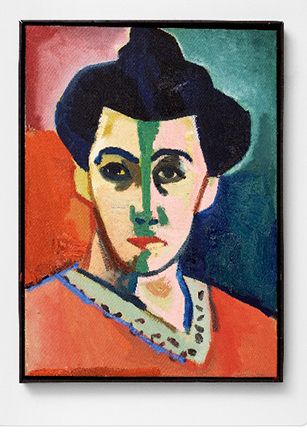
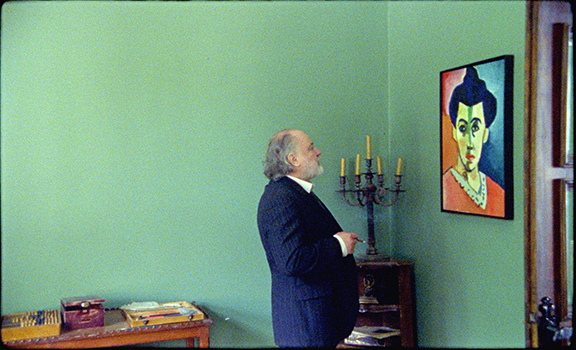
Untitled (after Henri Matisse’s “The Green Stripe”), 2023,
Oil on canvas, wooden frame, 72.5 × 52.5 cm,
Photo by Marek Gardulski, courtesy of the artist.
Particularly striking is a 2023 portrait inspired by Henri Matisse’s famous Portrait of Madame Matisse. The Green Stripe (1905). In the original painting, Matisse portrayed his wife, Amélie, dividing her face with a bold green stripe. The intense, almost clashing colors made the portrait one of the most recognizable works of Fauvism.
More than a century later, Wilhelm Sasnal revisits this composition. The familiar face appears in a new context, in a different time and a different story. In one scene, the portrait hangs on the wall behind the characters as they converse. It remains silent, yet it is difficult to escape the impression that it, too, is taking part in the scene. After all, it carries a history of its own, one that reaches far beyond the events unfolding on screen.
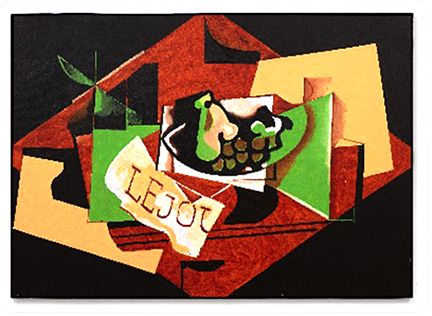
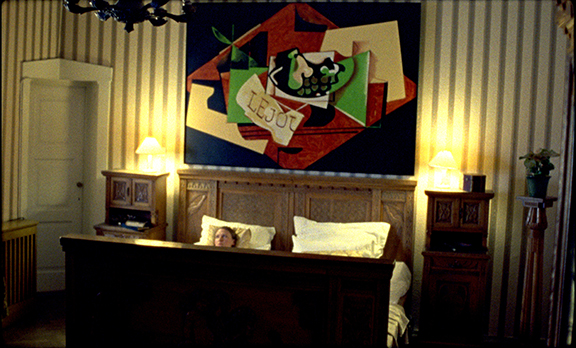
Untitled (after Georges Braque’s “Still Life”), 2023,
Oil on canvas, wooden frame, 202.5 × 142.5 cm,
Photo by Marek Gardulski, courtesy of the artist.
The same is true of a still life inspired by the work of Georges Braque. Fragmented forms, geometric divisions, and overlapping perspectives bring a sense of unease to the villa’s interior, reflecting the Cubist way of seeing the world. The painting hangs above Mrs. Tobler’s bed. As Sasnal explained in an interview with Apollo Magazine, the Cubist fragmentation of reality was intended to mirror the disintegration of the Tobler family’s seemingly orderly world. Beneath an outward appearance of stability and harmony lie deep internal fractures.
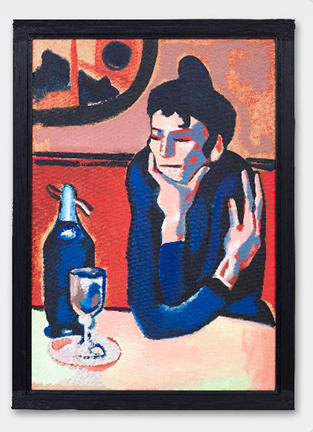
Untitled (after Pablo Picasso’s “The Absinthe Drinker”), 2023,
Oil on canvas, wooden frame, 110 × 80 cm,
Photo by Marek Gardulski, courtesy of the artist.
Among the paintings created for the film is also Sasnal’s interpretation of Pablo Picasso’s The Absinthe Drinker. In a conversation with Adam Szymczyk, Wilhelm Sasnal recalled that, in choosing the colors for this canvas, he sought to convey Mrs. Tobler’s loneliness. The painting is therefore more than a reference to art history. It also becomes a subtle commentary on the character’s emotional state.
An Encounter Between Eras
Why Matisse, Picasso, and Braque?
Robert Walser’s novel was published in 1908, at a time when European art was undergoing one of its most profound transformations. Just a year earlier, Picasso had painted Les Demoiselles d’Avignon, heralding a radically new way of seeing and representing reality. Matisse was experimenting with color, while Braque was breaking objects down into geometric forms. Painting was freeing itself from the obligation to faithfully reproduce the visible world.
Wilhelm Sasnal evokes the spirit of this artistic upheaval without attempting to reconstruct the period with museum-like precision. Here, the past meets the present, and the boundaries of time become surprisingly fluid.
Alongside references to the early twentieth-century avant-garde, motifs from entirely different decades appear. In one scene, Joseph Marti hangs a painting by Sasnal in his room, inspired by the cover of a 1984 album by the British band The Smiths. The film also makes room for a copy of a 1924 sculpture by Katarzyna Kobro, created by Sasnal himself.
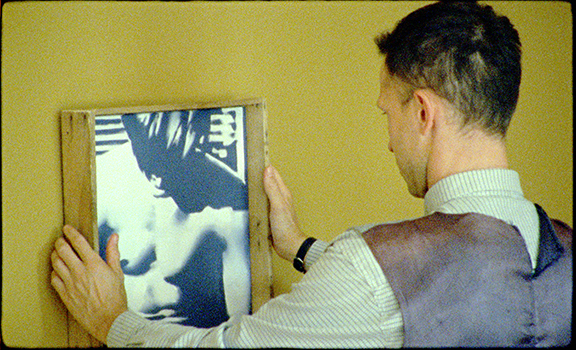
Joseph Marti wiesza w swoim pokoju obraz W. Sasnala inspirowany okładką albumu brytyjskiego zespołu The Smiths z 1984 r., fot. Marek Gardulski, dzięki uprzejmości artysty.
The result is a space where different eras and artistic styles mingle freely, much like memories that do not always follow a chronological order.
The paintings also reveal something about the villa’s owner. Carl Tobler is an ambitious man, confident in his abilities and eager to be seen as an inventor and a man of the modern age. The art he surrounds himself with may reflect his taste, but also his aspirations and desire for social recognition.
The interior of the house thus becomes a kind of portrait of its owner. What hangs on the walls speaks not only of Tobler’s artistic preferences, but also of the image he wishes to project.
Paintings That Step Out of the Frame
The story of these canvases, however, does not end on the film set.
In 2024, while The Assistant was still in production, the Stedelijk Museum in Amsterdam presented an exhibition titled Wilhelm Sasnal: Painting as Prop. It was curated by Adam Szymczyk, a Polish art critic known, among other things, for serving as the artistic director of documenta 14 in Kassel and Athens.
The exhibition, on view from March 30 to September 1, 2024, featured 25 paintings, including canvases created for the film as well as other works by Sasnal exploring recurring themes of art history, photography, and memory. The exhibition had already been planned while the film was in production, giving the paintings an opportunity from the outset to exist in both cinematic and museum settings.
The exhibition’s title itself suggested a certain paradox. Does a painting created as a film prop remain merely a prop? Is its meaning defined by the setting for which it was made?
In a film, paintings are part of a larger whole. The camera may linger on them for a moment or pass them by as it follows the characters. In a museum, the relationship is reversed. The paintings themselves take center stage, and viewers can devote as much time to them as they wish.
Yet the story of these paintings did not end with the final clap of the clapperboard. Wilhelm Sasnal returned to some of the canvases, reworking their compositions, enriching their painted surfaces, and moving further away from their original inspirations. In an interview with Apollo Magazine, he acknowledged that the paintings had initially been created rather quickly, primarily as film props. Only later did he feel the need to give them greater depth and independence as works of art.
And so their second life began. Created for the camera, they were now free from its gaze. In the museum, they no longer had to accompany the characters or serve the film’s narrative. They could speak in a language of their own — the language of painting.
Between Painting and Cinema
Wilhelm Sasnal is both a painter and a filmmaker, although he is reluctant to treat these two aspects of his work as a single artistic practice. In interviews, he emphasizes the differences between them. For him, cinema is primarily about storytelling unfolding over time, shaped by movement, events, and relationships between people. Painting follows a different set of rules.
And yet, in The Assistant, these two worlds come together in a particularly compelling way.
The paintings are more than mere decorations. They bring their own histories and meanings into the film. At times they remain almost unnoticed; at others, they catch the viewer’s eye with a familiar motif or an unexpected combination of colors. Together, they create a second, subtle layer of storytelling.
One can follow the story of Joseph Marti without recognizing a single artistic reference. But a closer look reveals another story unfolding behind the characters — the story of art itself, continually returning, taking on new meanings, and finding its place in new contexts.
In Anka and Wilhelm Sasnal’s film, painting moves beyond the boundaries of its frame to become part of cinema. It then leaves the screen and returns to the gallery, carrying with it the experience of another story.
For a painting, even one created for a film, need not remain in its shadow.
Sources:
- Stedelijk Museum, Amsterdam — Wilhelm Sasnal: Painting as Prop, exhibition, March 30 – September 1, 2024.
- Conversation between Wilhelm Sasnal and Adam Szymczyk, Stedelijk Museum, 2024.
- “The Set Pieces of Wilhelm Sasnal,” Apollo Magazine, March 21, 2025.
- Art Basel — materials on Wilhelm Sasnal’s paintings and his exhibition at the Stedelijk Museum.
- Robert Walser, Der Gehülfe (The Assistant), 1908.

